
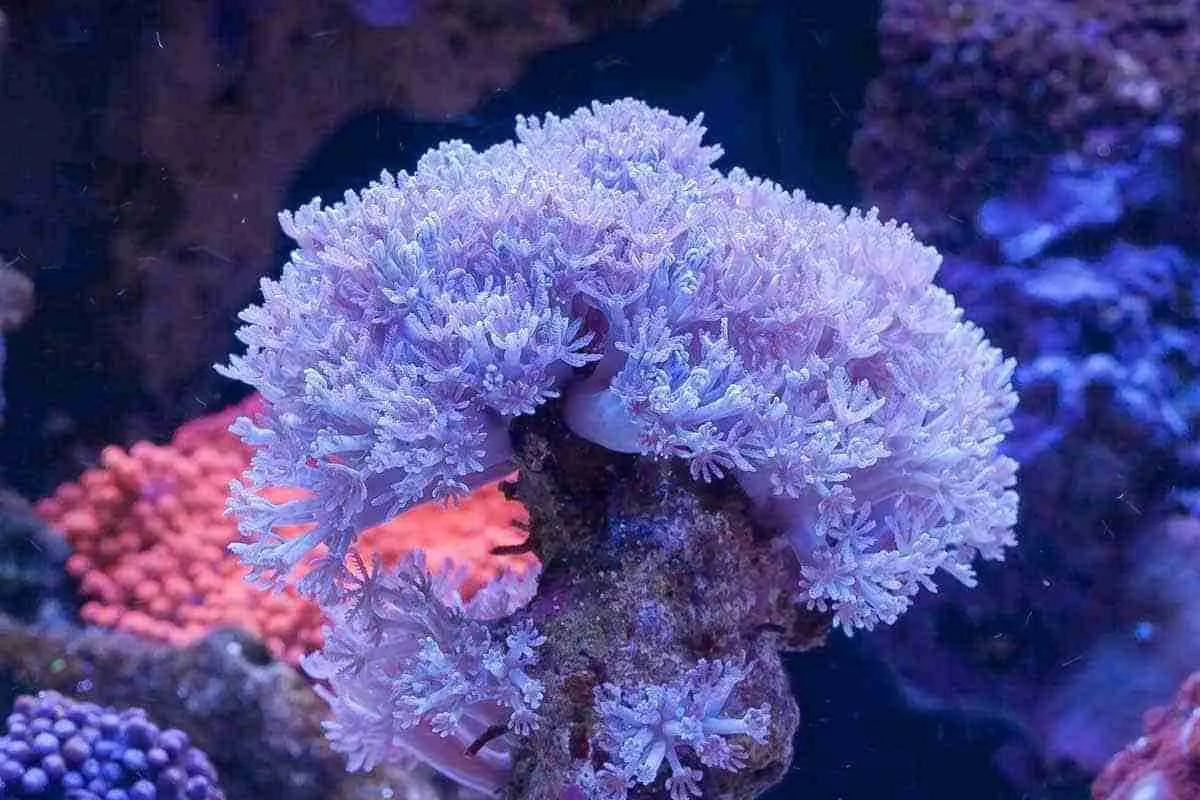
| Difficulty | Very easy |
| Time Required | 10–15 minutes |
| Healing Time | About 1 week |
| Best Method | Cut a branch, band or mesh it down |
| Coral Type | Fast-growing soft corals |
Overview
Pulsing Xenia and Kenya Tree barely need your help to propagate — Kenya Trees literally drop babies (branchlets detach, drift, and settle), and Xenia walks across rockwork splitting as it goes. Fragging is mostly a matter of catching that energy and pointing it at a plug. Like leathers, their slippery tissue shrugs off glue, so use bands, mesh or toothpicks.
What You’ll Need
- Sharp scissors or scalpel
- Rubber bands, bridal-veil mesh, or toothpicks + plugs/rubble
- A colander or rubble cup for the lazy method
Step-by-Step
- Snip a branch or stalk an inch or two long — for Xenia, take a stalk with several pulsing hands; for Kenya Tree, any branch (or just collect the dropped babies).
- Attach mechanically: rubber-band the stalk gently to a plug, pin the base with a toothpick, or lay pieces on rubble under mesh in a low-flow container.
- Wait about a week — these corals grip fast. Remove bands/mesh once attached.
- Alternatively, park a rubble cup next to the colony and let nature hand you attached frags.
Aftercare & Healing
Minimal. Xenia may stop pulsing for a few days after handling — normal. Both species grow visibly week to week once attached. Trim the parent regularly; with these corals, fragging is pruning.
What Can Go Wrong
Xenia melting after a move: Xenia hates transport and parameter swings more than cutting — frag in-tank when possible. Spreading where you don’t want it: the eternal Xenia/Kenya issue — keep them on isolated islands, and remove every scrap of tissue when evicting them (fragments regrow). Bands cutting tissue: loosen; snug only.
Related Care Guides
Pulsing Xenia · Kenya Tree Coral · Anthelia
Frequently Asked Questions
How do I frag Xenia or Kenya tree?
Cut a stalk or branch with a razor and attach it to rubble, rubber-banded or wedged, in low flow until it grabs. These weedy softies attach and spread fast.
Why does everyone warn about Xenia spreading?
Xenia and Kenya tree grow and multiply aggressively, walking across rock and overtaking other corals. Many keepers isolate them on a separate rock island so they cannot spread into the main aquascape.
Why is my Xenia not pulsing or melting?
Xenia can be oddly finicky about water chemistry despite being weedy, and sudden melting often follows parameter changes. Pulsing also varies with nutrient and flow conditions, so some variation is normal.