
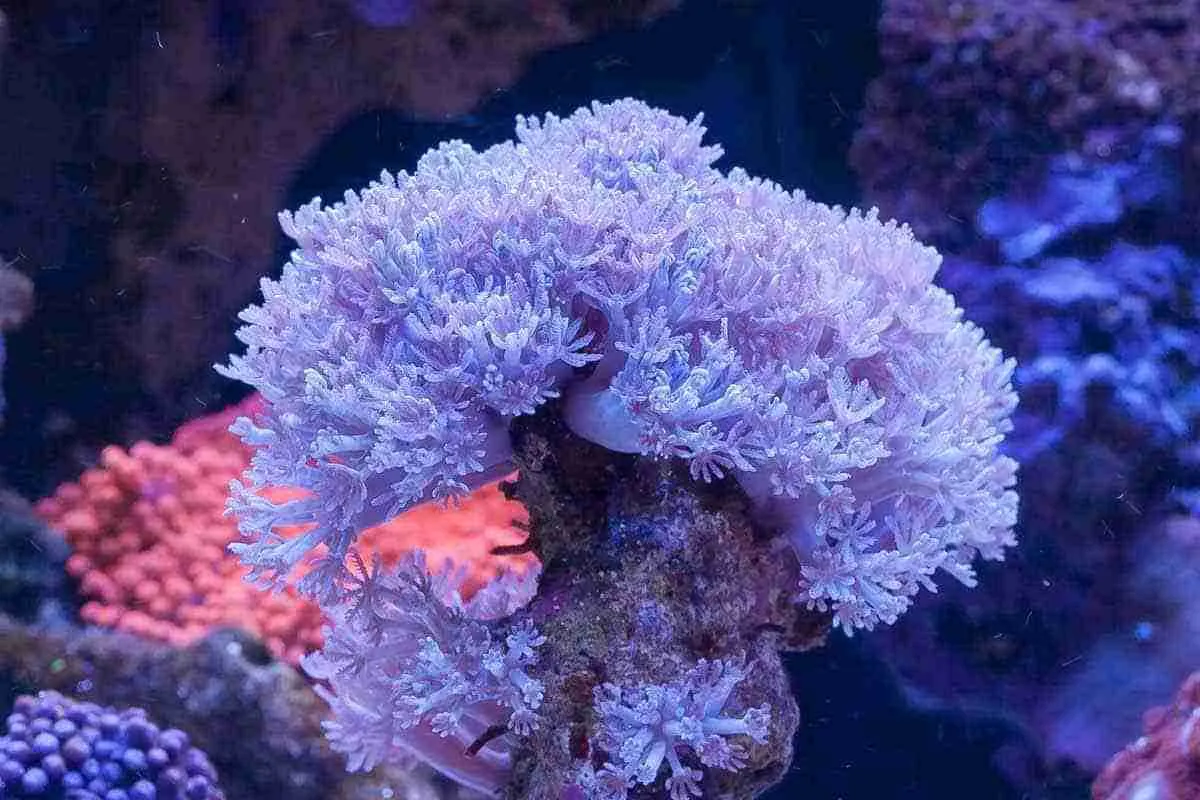
Xenia sp.
| Care Level | Easy |
| Lighting | Low to moderate |
| Water Flow | Low to moderate |
| Placement | Mid to upper rock |
| Aggression | Peaceful, but spreads fast |
| Coloration | Cream, tan, or pink pulsing polyps |
Overview
Pulsing Xenia is famous for its mesmerizing, rhythmic “pulsing” — its feathery polyps open and close like tiny grasping hands. It is a hardy, fast-growing soft coral that thrives in nutrient-rich tanks and is a popular, hypnotic beginner coral.
Care & Placement
Xenia does best in low-to-moderate light and gentle-to-moderate flow. Ironically it often pulses more strongly in slightly “dirtier” water. Place it where its spread can be controlled, as it propagates quickly across rock.
Feeding
Largely photosynthetic and absorbs nutrients directly from the water; it generally does not need target feeding. Some keepers find it thrives without any direct feeding at all.
Propagation
Frag by snipping a stalk near the base and letting it attach to a plug wedged in rubble (it can be tricky to glue). It spreads readily on its own.
Full step-by-step: How to Frag Xenia, Kenya Tree and Other Weedy Soft Corals
Cautions
A rapid spreader that can overtake rockwork — isolate it or prune regularly. Pulsing can stop temporarily after moves or parameter swings; usually resumes once settled.
Frequently Asked Questions
Why does pulsing xenia pulse?
Its polyps rhythmically open and close, likely to aid gas exchange and feeding. The pulsing is natural and a sign of a happy colony, though it varies with conditions and can stop without harm.
Is pulsing xenia easy to keep?
Yes and no. It’s hardy and grows fast, but oddly sensitive to water chemistry and can melt suddenly after parameter changes. It also spreads aggressively.
How do I stop xenia from taking over?
Keep it on an isolated rock island, since it walks across and overgrows the aquascape. Trimming and removing it from unwanted spots is the main control.