
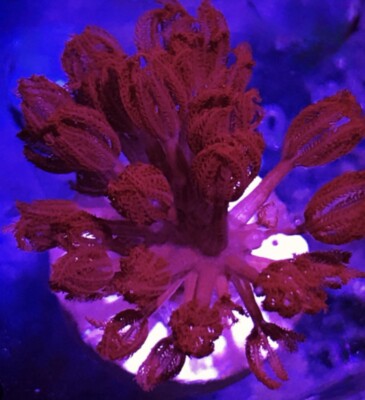
Xenia sp.
| Care Level | Easy to moderate |
| Lighting | Moderate |
| Water Flow | Moderate |
| Placement | Rock, mid tank — give it its own island |
| Aggression | Peaceful, but spreads rapidly |
| Coloration | Red / pink-red |
Overview
Red Xenia is a striking red-pigmented form of the pulsing soft coral Xenia. Like other xenias it grows as stalks topped with feathery, eight-tentacled polyps, and many colonies rhythmically open and close in the hypnotic “pulsing” motion the genus is famous for. The red coloration makes it a real standout against the usual cream and tan xenias, and it brings constant gentle motion to the reef.
Care & Placement
Easy to moderate, with one big caveat: it spreads. Give it moderate light and moderate flow. Unlike most corals, Xenia often does best in tanks that carry some nutrients rather than ultra-clean, nutrient-stripped water — it is thought to absorb dissolved organics directly. Place it on its own rock island, separated by open sand or bare rock, because it will readily march across the rockwork and overrun slower neighbors.
Feeding
Photosynthetic, and beyond that Xenia is believed to take up dissolved nutrients straight from the water, which is why it thrives in richer systems. No target feeding is needed — light plus a little nutrient in the water is all it asks.
Propagation
About as easy as coral propagation gets. Xenia spreads on its own and can simply be encouraged onto a piece of rubble: set rubble next to the colony and it will often creep onto it, or peel a stalk and rubber-band it on. The bigger challenge is usually stopping it, not spreading it.
Cautions
It can become invasive, overgrowing rock and shading out other corals, so keep it contained on an isolated island. Xenia is also notorious for boom-and-bust: a thriving colony can suddenly melt away for no obvious reason, then often regrow later — keep parameters stable and do not panic. Like other soft corals it releases mild compounds, so run activated carbon.
Frequently Asked Questions
Does Red Xenia pulse?
Many colonies do pulse, opening and closing their polyps rhythmically, but pulsing varies with the colony and conditions — some pulse constantly, others rarely, and red forms sometimes pulse a little less than the classic pulsing xenia. Flow, light, and water chemistry all influence it.
Is Red Xenia invasive?
It can be. Xenia spreads quickly across rockwork and can overgrow neighbors, so it is best kept on its own rock island separated by open sand or bare rock. It is easy to propagate but harder to contain.
Why did my xenia suddenly melt or crash?
Xenia is famous for unexplained boom-and-bust cycles — a healthy colony can recede or melt away with no clear cause and then regrow weeks later. Keeping parameters stable helps, but occasional crashes are a known quirk of the genus rather than something you did wrong.