
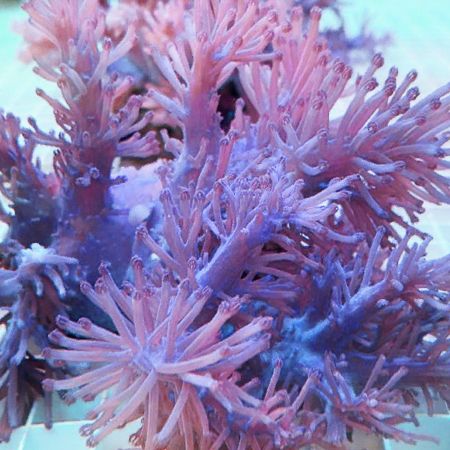
Cespitularia sp.
| Care Level | Moderate |
| Lighting | Moderate |
| Water Flow | Moderate |
| Placement | Rock, low to mid tank |
| Aggression | Peaceful (can spread) |
| Coloration | Iridescent blue / silvery teal |
Overview
Blue Cespitularia is one of the most sought-after soft corals for color — a pulsing coral in the same family as Xenia (Xeniidae) that shows a stunning iridescent blue to silvery-teal sheen under good light. It grows in small tree-like clumps of feathery, eight-tentacled polyps, and many colonies gently pulse. Its beauty comes with a reputation for being fussier than the average soft coral.
Care & Placement
Moderate. Cespitularia rewards a mature, stable tank and punishes swings. Give it moderate light (enough to hold the blue color, not so much it bleaches) and moderate flow to keep the polyps clean and extended. Place it on rock in the low-to-mid tank. Its Achilles heel is stability: sudden changes in parameters, temperature, or a young/unsettled system often cause it to recede or “melt” with little warning. Get it into a settled tank and leave it be.
Feeding
Photosynthetic. It draws most of its energy from light through its zooxanthellae, so target feeding is not required. Unlike a nutrient-starved SPS system, Cespitularia actually does better with a little nutrient in the water — ultra-low-nutrient conditions can work against it. Stable, lightly-fed reef conditions suit it best.
Propagation
Like other xeniids, it spreads on its own and is easy to propagate: snip or peel a small clump and rubber-band it onto a piece of rubble until it attaches. It is generally less aggressively invasive than pulsing Xenia, but it will still travel across rock over time, so give it its own island if you do not want it wandering.
Cautions
The big one is instability: Cespitularia can crash suddenly in an immature tank or after a parameter swing, so it is not a good first coral. Like other soft corals it engages in mild chemical warfare, so run activated carbon and give sensitive neighbors some space. And because it can spread, keep it off rock that connects to prized corals if you want to contain it.
Frequently Asked Questions
Why is my Cespitularia melting or receding?
It is very sensitive to instability. A young or unsettled tank, a parameter swing, or a temperature spike can cause it to recede or “melt” quickly. It does best in a mature, stable system that is left alone once the coral has settled.
Does Blue Cespitularia pulse like Xenia?
Many colonies do gently pulse, opening and closing their polyps, though usually less vigorously and less reliably than pulsing Xenia. Pulsing varies from colony to colony and with conditions, so some pulse constantly and others rarely.
Is Blue Cespitularia hard to keep?
It is more demanding than easy soft corals like green star polyps or pulsing xenia — not because it needs much, but because it needs stability. Give it a mature tank and steady parameters and it can thrive; put it in a new tank and it often fails.