
Overview
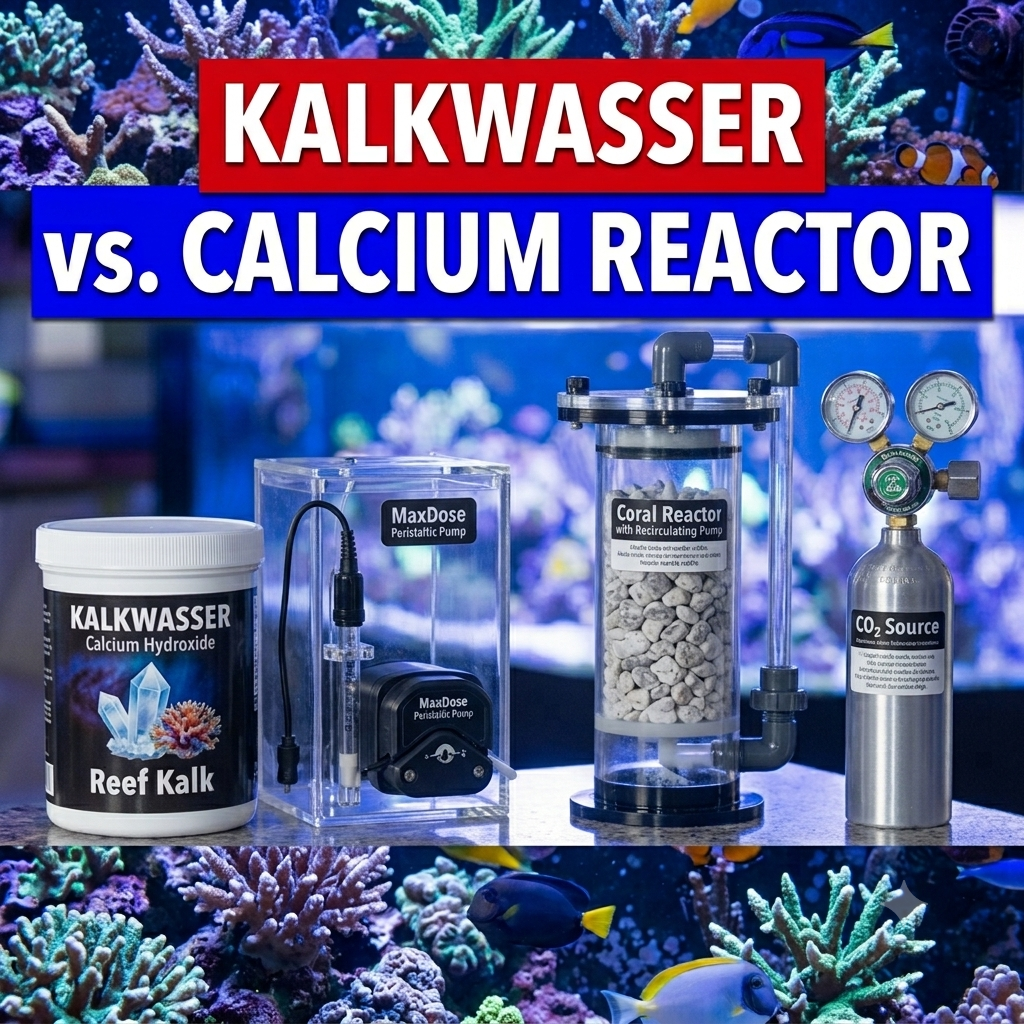
Growing corals constantly consume calcium and alkalinity to build skeleton, and you have to replace what they use. The three main ways to do it are kalkwasser, two-part dosing, and a calcium reactor. All keep calcium and alkalinity stable; they just suit different tank sizes and demands.
Kalkwasser (Limewater)
Kalkwasser is calcium hydroxide mixed into your top-off water. As it replaces evaporation it adds calcium and alkalinity and, as a bonus, boosts pH and helps precipitate phosphate. It is cheap and simple but limited: you can only add as much as your evaporation allows, so it suits low-to-moderate demand tanks and is often combined with another method.
Two-Part Dosing
Two separate solutions, one calcium and one alkalinity, dosed daily by hand or by a dosing pump to replace what corals use. It is precise, scalable, and easy to dial in, which makes it the most popular method for small-to-medium reefs. The downside is buying or mixing solutions and the ongoing cost as demand grows.
Calcium Reactor
A calcium reactor dissolves media (crushed aragonite) with CO2 to release calcium and alkalinity in balance, then feeds it to the tank. It is the go-to for large or SPS-heavy systems with high demand, very stable and cost-effective at scale, but the most complex to set up and tune, involving CO2, pH monitoring, and effluent adjustment.
Which Should You Use?
Small tank or modest coral load: two-part (or kalkwasser) is simplest. Growing SPS demand: two-part scales until it gets tedious. Large, high-demand reef: a calcium reactor pays off. Many reefers run a combination, such as a calcium reactor for the bulk plus kalkwasser in the top-off for pH.
Frequently Asked Questions
What is the difference between kalkwasser, two-part, and a calcium reactor?
All replace the calcium and alkalinity corals consume. Kalkwasser adds them through your top-off water, two-part doses separate calcium and alkalinity solutions daily, and a calcium reactor dissolves media with CO2 to supply both in balance. They suit increasing tank sizes and demands respectively.
Which calcium and alkalinity method is best for beginners?
Two-part dosing. It is precise, easy to adjust, scales with your tank, and doesn’t require the CO2 and tuning of a calcium reactor. Kalkwasser is also simple but limited by your evaporation rate.
When do I need a calcium reactor?
When your tank’s calcium and alkalinity demand outgrows what two-part dosing can comfortably keep up with, typically large or SPS-dominated systems. Below that, two-part or kalkwasser is simpler and just as effective.
Can I combine these methods?
Yes, and many reefers do. A common setup is a calcium reactor for the bulk of the demand plus kalkwasser in the top-off to support pH, or two-part to top up during growth spurts. They complement each other well.