
Overview
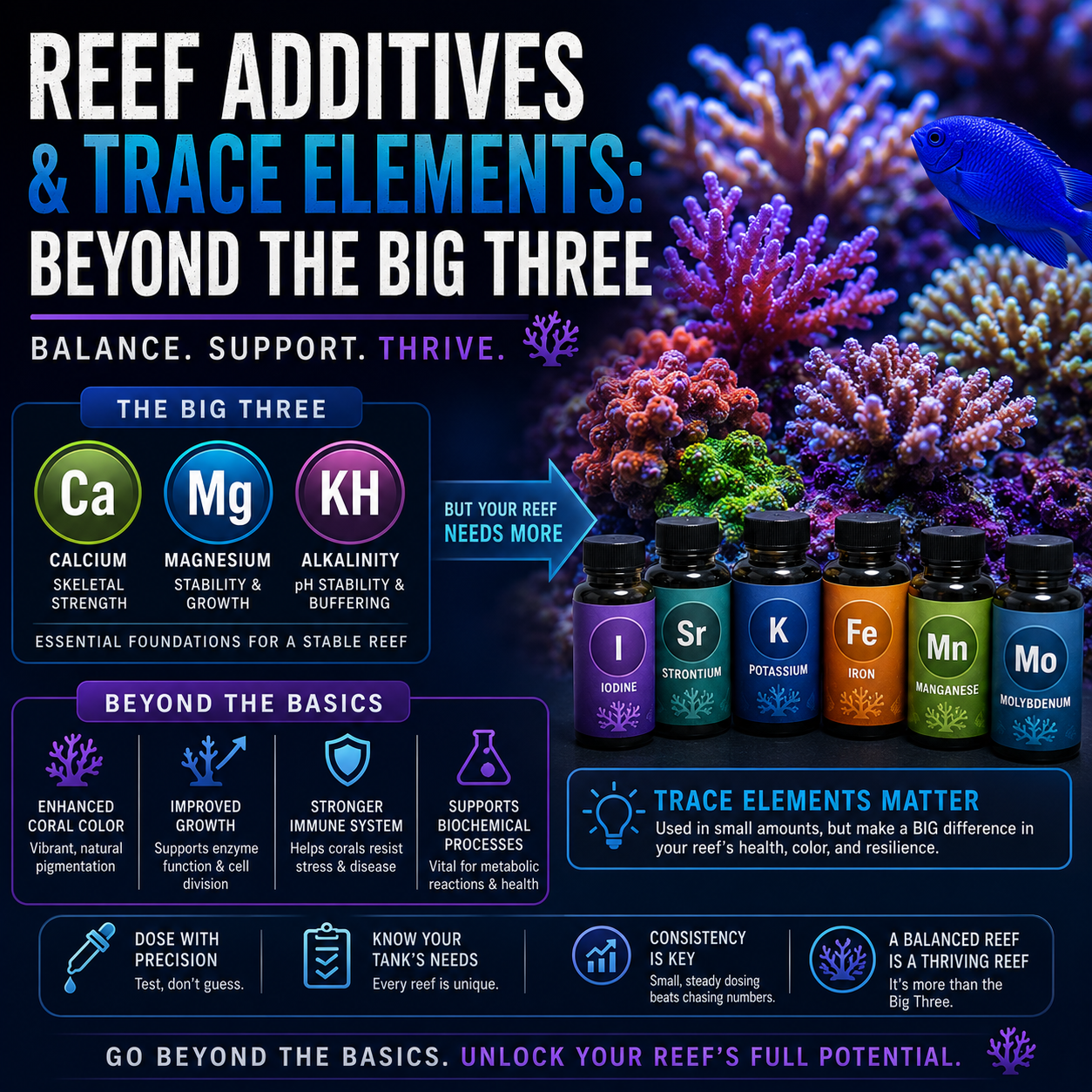
Once you have the “Big Three” — alkalinity, calcium, and magnesium — dialed in, it is tempting to start pouring in every supplement on the shelf: strontium, iodine, potassium, iron, amino acids, and mystery “trace element” blends. This guide breaks down what each one actually does, when it is genuinely needed, and the honest truth about how most reefers should approach the minor and trace elements.
The Big Three vs. Everything Else
Corals build their skeletons mostly from calcium and carbonate (alkalinity), with magnesium keeping that chemistry stable — those are consumed in large amounts and must be replenished, which is why they get their own guides. Everything below is consumed in tiny amounts. The key idea: minor and trace elements are used slowly, and for most tanks a regular water change already replaces them. Targeted dosing is an advanced tool, not a default.
Strontium
Strontium is incorporated into coral skeletons alongside calcium and is often credited with supporting SPS growth. It is consumed slowly, and whether it needs separate dosing is genuinely debated — many successful SPS keepers never dose it, relying on water changes and the strontium that comes in with salt mix and two-part. If you dose it, do so based on a test, not on faith.
Iodine / Iodide
Iodine supports soft corals, is used by macroalgae, and is important for molting crustaceans like shrimp and crabs; it is also linked to coral coloration. It oxidizes and is used up fairly quickly, so it is one of the more commonly-dosed trace elements — but it is easy to overdose, and too much is harmful. Go light, and ideally test.
Potassium
Potassium is one of the more abundant “minor” ions and is tied to coral coloration, especially reds and deep colors in SPS. Heavily-stocked SPS tanks can draw it down. It is testable, so if your reds look washed out and your other parameters are right, a potassium test (and modest dosing to bring it into range) is worthwhile — again, test first.
Iron
Iron is mainly a refugium additive: it fuels the growth of chaetomorpha and other macroalgae, which in turn strips more nitrate and phosphate from your water. If your fuge macro is growing slowly and pale, a little iron often kick-starts it. It is not something a coral-only display usually needs dosed directly.
Amino Acids
Not an element, but a hugely popular additive: amino acids are building blocks corals use for tissue growth and color, and dosing them can boost growth and coloration, particularly in leaner (low-nutrient) SPS systems. Use sparingly — overdosing feeds bacteria and can cloud water or spike nutrients. Think of them as coral food, not a mineral.
Other Trace Elements
Manganese, boron, and a long list of other elements round out seawater, and many keepers dose an all-in-one trace blend for insurance. These are consumed in vanishingly small amounts, and the risk of blindly dosing many at once is accumulation and imbalance. A balanced trace mix at label doses is generally safe; individually dosing exotic elements without testing is where people get into trouble.
The Honest Approach
For the great majority of reef tanks, regular water changes with a quality salt mix replenish the minor and trace elements automatically — no separate dosing required. Targeted dosing earns its place in advanced, heavily-stocked, or low-nutrient SPS systems that consume elements faster than water changes replace them. And when you do dose, be test-driven: use an ICP test to see what is actually low, correct that, and re-test. Do not chase numbers you cannot measure or dose “just in case” — that is how tanks end up with toxic accumulations.
Related Guides
- Alkalinity, Calcium & Magnesium
- How to Dose Two-Part
- Water Changes: How Much & How Often
- Algae Scrubbers (ATS)
Frequently Asked Questions
Do I need to dose trace elements in my reef tank?
Usually not, if you do regular water changes — a quality salt mix replaces minor and trace elements automatically. Targeted dosing is mainly for advanced, heavily-stocked, or low-nutrient SPS tanks that use elements faster than water changes replace them.
What is the difference between dosing and water changes?
Water changes replenish everything in seawater at once, gently and in balance, which covers most tanks. Dosing adds a specific element in a targeted amount — useful when one thing is being consumed quickly, but riskier because it is easy to overdose or unbalance the water.
How do I know which additives to dose?
Test first. An ICP test shows which elements are actually low in your specific tank; correct those, then re-test. Dosing blindly or “chasing colors” without testing is the main way reefers cause toxic accumulations and instability.