
| What It Is | Salt concentration of your water |
| Reef Target | 1.025–1.026 SG (~35 ppt) |
| Best Tool | Refractometer (calibrated) |
| Fish-Only OK | 1.020–1.025 SG |
| Golden Rule | Keep it stable; top off evaporation |
Overview
Salinity is how much salt is dissolved in your water, and for a reef tank it needs to sit in a narrow range and stay there. Corals and invertebrates are far less tolerant of salinity swings than fish. The good news: salinity is easy to measure and control once you understand that evaporation is what moves it — and that you replace evaporation with fresh water, not saltwater.
Target and Measurement
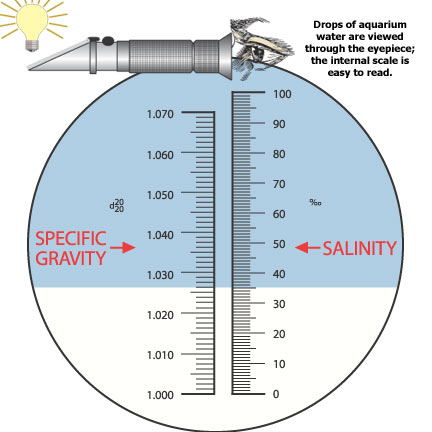
Keep a reef at 1.025–1.026 specific gravity (about 35 ppt), the same as natural seawater. Measure with a refractometer — cheap swing-arm hydrometers are notoriously inaccurate. Calibrate the refractometer with calibration fluid (not just RODI) and rinse it between uses. Fish-only tanks can run a bit lower (1.020–1.025), sometimes intentionally to reduce parasites.
How to Keep It Stable
- When water evaporates, salt stays behind and salinity rises — so top off evaporation with fresh RODI water, never saltwater.
- Automate top-off if you can (an ATO); steady daily top-off keeps salinity from drifting between water changes.
- Match new saltwater to tank salinity during water changes — mix, measure, and adjust before it goes in.
- Check salinity weekly, and any time evaporation has been unusually high (hot weather, open lids).
Common Mistakes
Topping off with saltwater: drives salinity ever higher — evaporation loses water, not salt. Trusting an uncalibrated tool: a refractometer off by a few points can push corals out of range without you knowing. Big fast corrections: if salinity has drifted, walk it back slowly over a day or two — sudden swings stress everything.
Related Guides
Frequently Asked Questions
What salinity should a reef tank be?
About 35 ppt, which reads roughly 1.026 specific gravity at 77 degrees. Fish-only tanks can run slightly lower, but corals and inverts do best at natural seawater salinity.
What is the difference between salinity and specific gravity?
Salinity is the actual salt content; specific gravity is a density reading that estimates it and shifts with temperature. A refractometer measures salinity directly and is far more reliable than a swing-arm hydrometer.
How do I keep salinity stable?
Top off evaporated water with fresh RODI, not saltwater. Salt does not evaporate, so replacing evaporation with saltwater slowly drives salinity up. An auto-top-off keeps it steady automatically.