
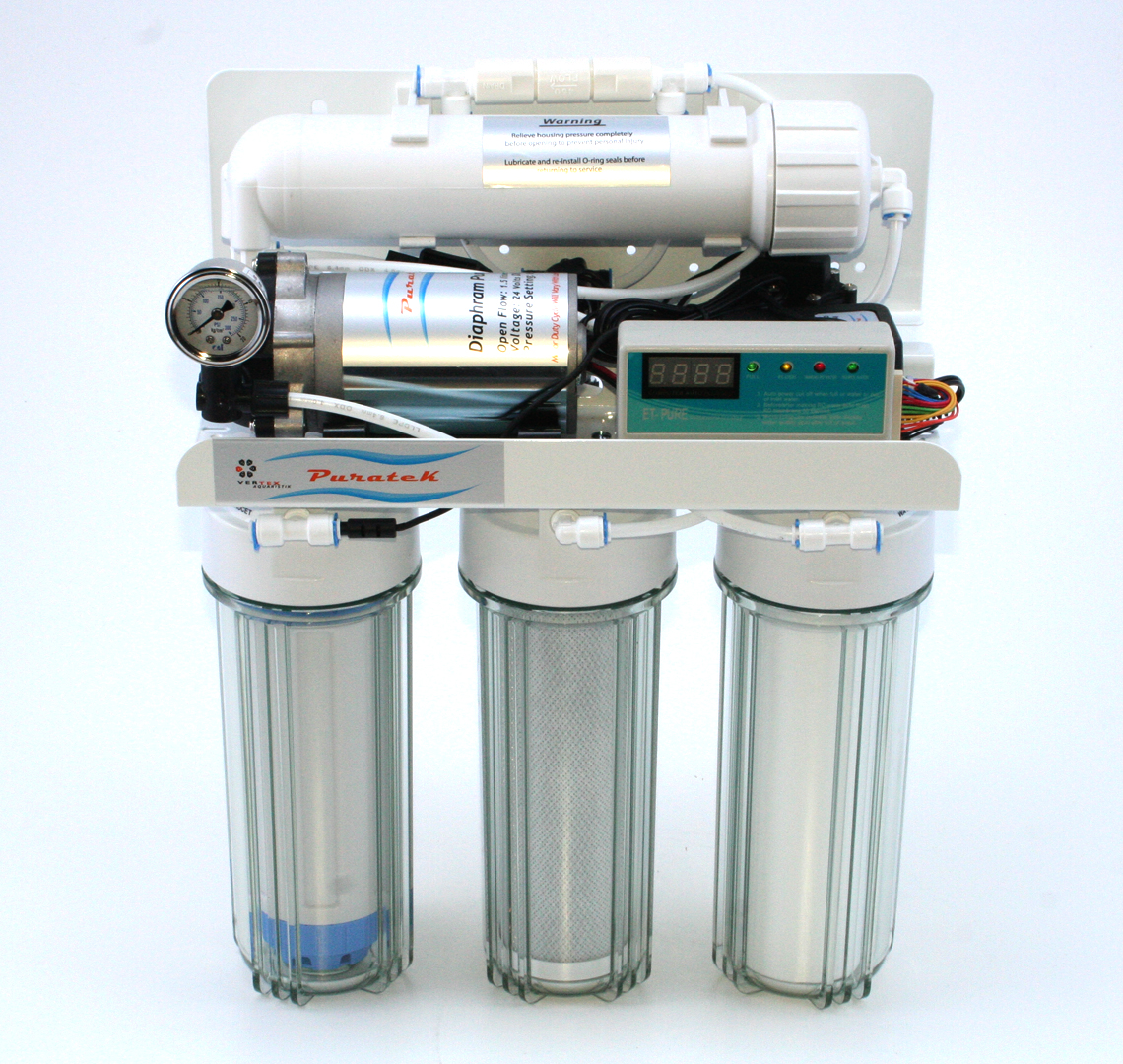
| What It Is | Reverse-osmosis / deionization filter |
| Makes | 0-TDS pure water for the tank |
| Typical Stages | Sediment, carbon, RO membrane, DI |
| Key Spec | GPD rating + waste ratio |
| Golden Rule | Buy a TDS meter with it |
Overview
If RODI water is the foundation of a healthy tank, the RODI unit is how you make it at home. These wall- or cabinet-mounted units run tap water through several stages to strip out everything — sediment, chlorine, dissolved solids — leaving 0-TDS water for mixing salt and topping off. Choosing one is mostly about stages, output rate, and matching it to your tap water.
What the Stages Do
A typical 4-stage unit: a sediment filter (grit), a carbon block (chlorine/chloramine — critical, since chlorine destroys the RO membrane), the RO membrane (the heart, removing ~90–98% of dissolved solids), and a DI resin stage that polishes the last bit to 0 TDS. Reef keeping needs that final DI stage — drinking-water RO units without it won’t hit zero.
How to Choose
- GPD rating (gallons per day): 75 GPD suits most home reefers; bigger tanks or frequent changes want 100+.
- Include DI — RO/DI, not plain RO, for true 0 TDS.
- Waste ratio — RO makes waste water; better units waste less per gallon of product.
- Add a dual TDS meter — so you can see output quality and know when membrane or DI is spent.
- Match your water pressure — low household pressure hurts output; a booster pump helps.
Maintenance
Replace sediment/carbon prefilters on schedule (they protect the pricey membrane), and swap DI resin when output TDS climbs off zero. A cheap inline or handheld TDS meter is non-negotiable — it’s how you catch a spent filter before it passes impurities that feed algae.
Common Mistakes
Buying RO without DI: won’t reach 0 TDS — you need the DI stage. Never checking TDS: spent filters quietly pass solids. Skipping carbon changes: chlorine slips through and ruins the RO membrane — the most expensive part.
Related Guides
Why RODI Water Matters · How to Beat Hair Algae (Green Hair Algae)
Frequently Asked Questions
How many stages should an RODI unit have?
A good unit is usually 4 to 5 stages: sediment, one or two carbon blocks, the RO membrane, and a DI resin stage. The carbon stages protect the membrane from chlorine.
What is a normal waste-water ratio?
Most units make roughly 3 to 4 parts waste to 1 part pure water. That is normal, and the waste is just tap water you can reuse for laundry, plants or cleaning.
How do I know when to change the filters?
A TDS meter tells you: rising TDS after the membrane means it is failing, and any TDS after the DI stage means the resin is spent. Sediment and carbon are usually changed every 6 to 12 months.