
Overview
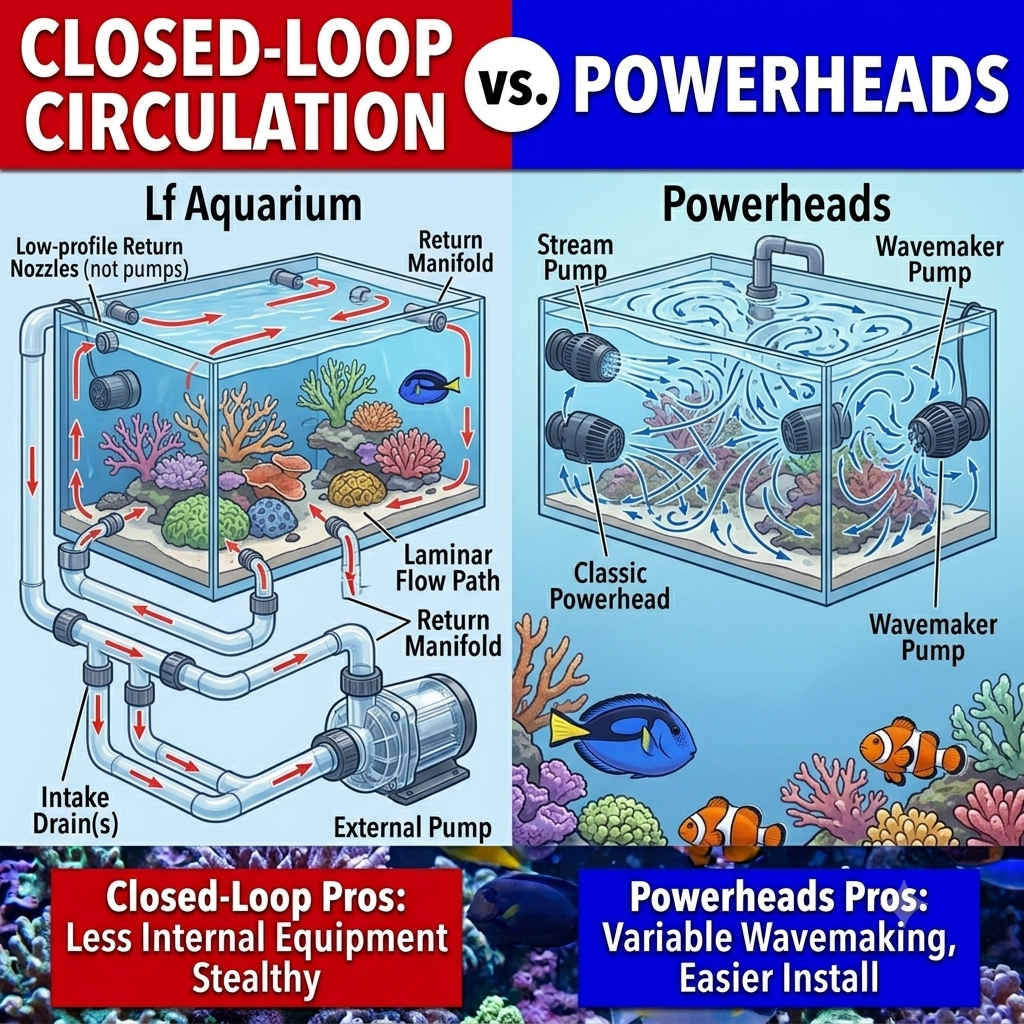
Every reef needs strong, random water movement, and there are two main ways to get it: in-tank powerheads (wavemakers) or a closed-loop system, an external pump plumbed to draw water from the tank and push it back through multiple outlets. Both create flow. They just do it differently, with real trade-offs.
How a Closed Loop Works
A closed loop is a sealed circulation circuit. An external pump pulls water from the display through a strainer or overflow and returns it through several nozzles or a manifold aimed around the tank. The water never leaves the system; it is simply circulated, so no pump sits inside the display.
Powerheads, the Alternative
Powerheads and wavemakers are compact pumps that sit inside the tank and push water directly. Modern controllable DC powerheads can pulse, alternate, and simulate waves, and they are far easier to add or reposition than plumbing a closed loop.
The Trade-offs
A closed loop keeps the display clear of equipment for a cleaner look and can move a lot of water quietly from one external pump, but it is a plumbing project: harder to install, harder to change, and a single point of failure if the pump dies. Powerheads are cheap, flexible, and easy, but they clutter the tank, need periodic cleaning, and multiple units add up. Most modern reefers choose controllable powerheads for the flexibility, while closed loops shine in large or built-in display tanks where hiding equipment matters.
Common Mistakes
Undersizing flow, aiming outlets straight at corals (which damages them), and creating one steady laminar current instead of random turbulence. Whichever method you use, aim for varied, glancing flow that reaches every part of the tank with no dead spots.
Frequently Asked Questions
What is a closed-loop circulation system?
An external pump plumbed to draw water from the display and return it through multiple outlets, circulating flow without the water leaving the system. It keeps powerheads out of the tank for a cleaner look.
Are powerheads or a closed loop better?
For most home reefs, controllable powerheads win on flexibility, cost, and ease. Closed loops shine in large or built-in tanks where hiding equipment and moving big volumes quietly matter, at the cost of a harder install.
Is a closed loop worth the extra work?
It depends on your goals. If you want a clean display with no equipment on the glass and you are comfortable with plumbing, yes. If you value flexibility and simplicity, modern powerheads deliver excellent random flow with far less effort.
How much flow does a reef tank need?
A common target is roughly 20 to 40 times the tank volume per hour in total turnover, delivered as random, turbulent flow with no dead spots. Placement and randomness matter more than the raw number.