
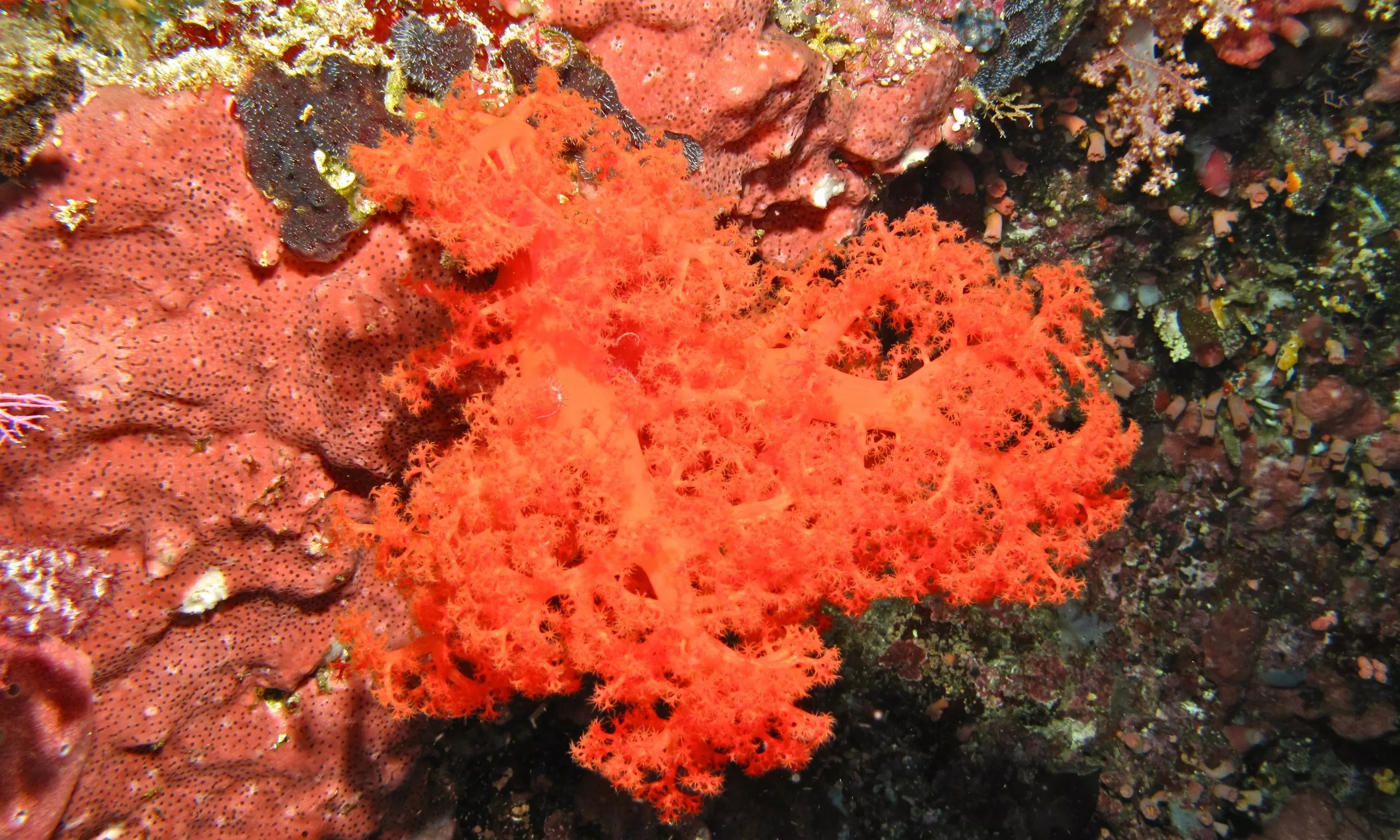
Scleronephthya spp.
| Care Level | Expert only |
| Lighting | Low (non-photosynthetic — light not needed) |
| Water Flow | Strong |
| Placement | Shaded overhang / underside of rock |
| Aggression | Peaceful |
| Coloration | Orange, red, pink, yellow |
Overview
Silk corals (Scleronephthya), also sold as strawberry corals, are among the most vividly colored corals in the hobby — translucent tree-like branches tipped with clusters of feeding polyps in brilliant orange, red, pink, or yellow. They are also among the hardest corals to keep alive. Like their close relative the carnation coral, they are non-photosynthetic and depend entirely on captured food.
Care & Placement
Expert only. Because Scleronephthya has no zooxanthellae, lighting is irrelevant to its survival — it is typically mounted on a shaded overhang or the underside of rock, in strong, varied flow that carries food to the polyps and stops detritus settling. The real challenge is nutrition: it must be fed fine planktonic food several times a day, which fouls the water and demands aggressive nutrient export. Most specimens slowly starve over weeks to months in an ordinary reef tank, so it should only be attempted in a dedicated non-photosynthetic (NPS) system.
Feeding
This is the whole game. Silk coral is entirely dependent on captured food — fine phytoplankton and zooplankton, rotifers, oyster eggs and similar — broadcast multiple times per day, ideally with the pumps briefly off so the polyps can catch it. Success comes down to feeding heavily and frequently while keeping water quality in check; too little food and it starves, too much and water quality crashes.
Propagation
Rarely propagated in captivity given how poorly it survives to begin with. Cuttings can be attached to rubble, but expect low success unless the parent colony is genuinely thriving in a dedicated NPS setup.
Cautions
One of the highest-mortality corals in the trade — do not buy it on impulse for a standard reef. It is frequently confused with, and closely related to, the carnation coral (Dendronephthya); both are demanding non-photosynthetic soft corals with the same heavy-feeding requirement. Bright color at the store is no guarantee of long-term survival, since these corals often coast for a while on reserves before slowly declining.
Frequently Asked Questions
Why are silk (strawberry) corals so hard to keep?
They are non-photosynthetic, so they get no energy from light and must be fed fine plankton several times a day. In a normal reef tank they are almost always underfed and slowly starve, which is why survival rates are poor.
Do silk corals need bright light?
No. Scleronephthya has no symbiotic algae, so light is irrelevant to feeding — they are usually placed in shade or under an overhang. What they need is strong flow and frequent feeding, not intense lighting.
What is the difference between silk coral and carnation coral?
They are close relatives — silk coral is Scleronephthya, carnation coral is Dendronephthya. Both are brightly colored, non-photosynthetic soft corals with the same very demanding, heavy-feeding care, and they are easily confused at a glance.