
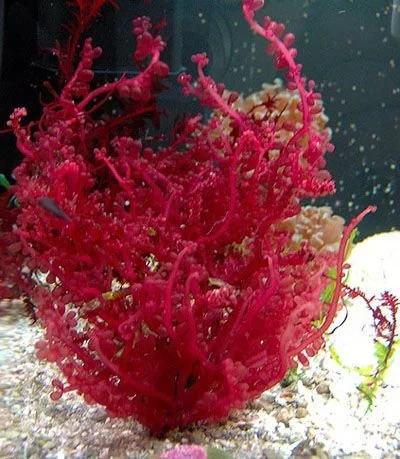
Botryocladia occidentalis
A note on the name. Like its relatives this is a red alga (Botryocladia), not a true Caulerpa — true Caulerpas are green algae that spread by runners, which this does not. B. occidentalis is the common Caribbean and western Atlantic species and the one most often imported. Compare the closely related Grape Caulerpa (B. uvaria), which is sold under an overlapping name.
| Care Level | Moderate |
| Lighting | Low to moderate |
| Water Flow | Low to moderate |
| Placement | Display or refugium, anchored in rock or rubble |
| Aggression | Peaceful |
| Coloration | Rich burgundy to deep red |
Overview
The classic red grape algae of the Caribbean and western Atlantic, and the species most commonly imported under the name. It carries plump, glossy, fluid-filled bladders on short branching stalks, giving the whole cluster the look of a bunch of ripe red grapes. It is one of the few macroalgae genuinely worth keeping for looks alone, and it makes a striking centerpiece in a display refugium.
Care & Placement
Anchor it in the rockwork or wedge it into rubble where flow is gentle to moderate and light is modest. It appreciates a spot that is not blasted by a powerhead, since the bladders are easily damaged. Growth is steady rather than fast, and it holds its shape well without the constant trimming a Caulerpa demands.
Feeding
Photosynthetic, drawing nitrate and phosphate from the water as it grows. Its export capacity is modest compared with Chaetomorpha because it grows slowly — treat that as a bonus rather than the main reason to keep it. Iron and trace element dosing helps maintain the deep burgundy colour.
Propagation
Divide an established cluster at the base and reattach the divisions to rubble. It is slower to take than a true Caulerpa, so give new divisions a settled, low-traffic spot and time to anchor.
Cautions
The bladders are fragile and will rupture in strong flow or under grazing, and a heavily damaged clump can foul water as it breaks down. Tangs, rabbitfish, some angelfish and urchins will eat it, so choose tankmates accordingly. It also dislikes ultra-low-nutrient systems — in a heavily stripped tank it slowly shrinks away rather than thriving.