
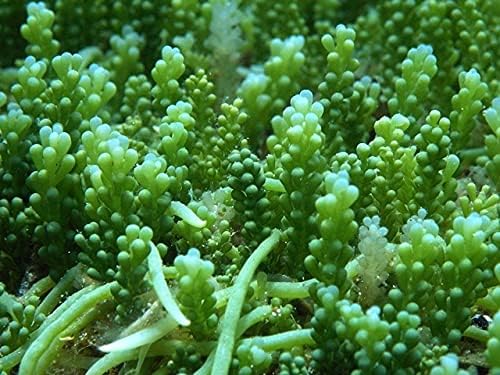
Botryocladia uvaria
A note on the name. Despite being sold as “Grape Caulerpa,” this is a red alga in the genus Botryocladia — not a true Caulerpa, which are green algae. The practical upshot is a good one: it does not send out the invasive runners true Caulerpa is known for. Do not confuse it with the closely related Red Grape Caulerpa (Botryocladia occidentalis), the common Caribbean species — the two are sold under overlapping names, and species-level identification within this genus is notoriously loose in the trade.
| Care Level | Moderate |
| Lighting | Low to moderate |
| Water Flow | Low to moderate |
| Placement | Display or refugium, wedged into rock or attached to rubble |
| Aggression | Peaceful |
| Coloration | Deep red to burgundy |
Overview
One of the most ornamental macroalgae in the hobby — clusters of glossy, fluid-filled bladders that look uncannily like a tiny bunch of red grapes, growing from a small holdfast. Because it spreads by slowly enlarging its clump rather than running across the rockwork, it behaves far better in a display tank than the true Caulerpas.
Care & Placement
Wedge it into the rockwork or attach it to a piece of rubble in gentle to moderate flow under modest light. It is slower growing and a little fussier than Chaetomorpha or Caulerpa: strong flow tears the bladders, and in a very lean, ultra-low-nutrient tank it will gradually shrink away rather than thrive.
Feeding
Photosynthetic, taking up nitrate and phosphate as it grows. Because growth is slow its nutrient export is modest next to Chaetomorpha — keep this one for how it looks first and export second. Iron and trace element dosing helps hold the deep red.
Propagation
Divide a cluster at the holdfast and reattach the pieces to rubble. Slower and less reliable than propagating a true Caulerpa, so be patient with it.
Cautions
The bladders are fragile: strong flow, careless handling or grazing fish will pop them, and a badly damaged clump can foul the water as it breaks down. Tangs, rabbitfish and urchins will eat it. Do not rely on it as your primary nutrient exporter, and do not starve it — it needs stable, modest nutrients rather than near-zero.