
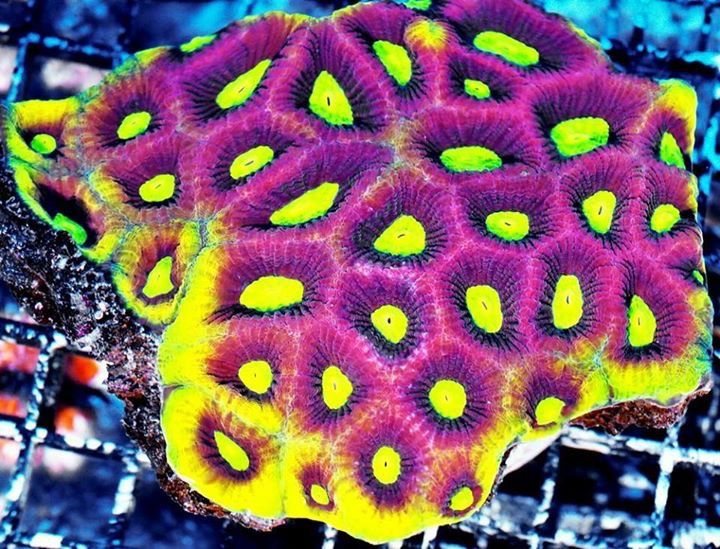
Goniastrea sp.
| Care Level | Easy to moderate |
| Lighting | Low to moderate |
| Water Flow | Moderate |
| Placement | Rock or sand, low to mid tank |
| Aggression | Semi-aggressive (night sweepers) |
| Coloration | Green, tan, with contrasting walls |
Overview
Goniastrea, one of the “pineapple” or moon brain corals, forms rounded, encrusting colonies of neat, walled corallites in a honeycomb pattern, closely resembling and closely related to Favia and Favites. Green and tan forms with bright contrasting corallite walls are common. It is a hardy, undemanding brain coral and a great, forgiving LPS.
Care & Placement
Easy to moderate. It does well in low to moderate light and moderate flow, on rock or the sand bed. It is adaptable and tolerant of normal reef conditions, which makes it a solid beginner-to-intermediate brain coral. Give it a little space, as it can reach neighbors after dark.
Feeding
Photosynthetic, but like other brains it appreciates feeding — at night it extends feeding tentacles that take meaty foods such as mysis or chopped seafood. Occasional feeding improves growth and color, though it is not essential.
Propagation
Fragged with a band saw between corallites, each frag carrying one or more whole corallites, then glued to a plug. It encrusts and heals well.
Cautions
Like Favia and Favites it extends sweeper tentacles at night that can sting nearby corals, so give it open space from close neighbors. Otherwise it is one of the more trouble-free stony corals.
Frequently Asked Questions
Is Goniastrea the same as a Favia or Favites?
They are close relatives and look similar — all are walled, honeycomb-corallite brain corals, and the common names (pineapple, moon, brain) overlap. Goniastrea is its own genus but takes the same easygoing care as Favia and Favites.
Is Goniastrea good for beginners?
Yes. It is hardy, adaptable, and undemanding on light and flow, which makes it a great early brain coral. Just give it space, since it stings with night-time sweeper tentacles.
Does Goniastrea need to be fed?
Not strictly — it is photosynthetic — but it responds well to feeding meaty foods at night, which supports better growth and color.