
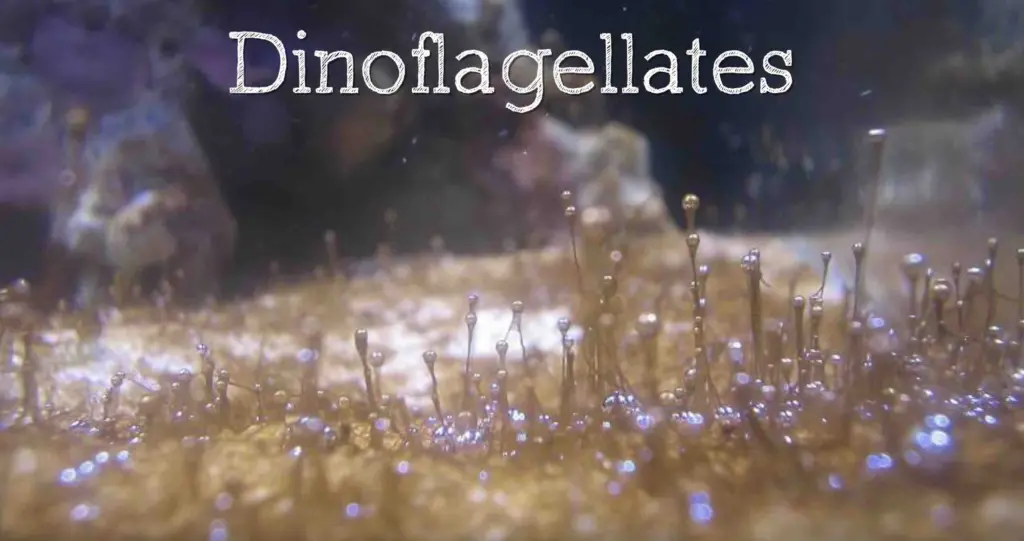
| What It Is | Nuisance dinoflagellate microorganisms |
| Looks Like | Brown snotty strings with bubbles |
| Main Cause | Ultra-low nutrients / sterile tank |
| Difficulty | Hard — the tricky one |
| Best Fixes | RAISE nutrients, biodiversity, UV |
Overview
Dinoflagellates are the pest that breaks the usual rules. Most nuisances thrive on high nutrients; dinos often explode when nutrients are too low — a sterile, over-cleaned tank with nitrate or phosphate bottomed out at zero. They’re also genuinely hazardous: some strains are toxic and can wipe out a cleanup crew. Beating dinos usually means doing the opposite of what you’d do for algae: rebuild nutrients and biodiversity so other microorganisms out-compete them.
How to Identify It
Brown, tan, or mustard stringy snot that coats rock, sand and corals, typically studded with oxygen bubbles, growing through the day under light and often receding at night. It’s slimy and stringy rather than hairy, and it comes back within hours of removal. If your cleanup crew is mysteriously dying, suspect toxic dinos.
How to Get Rid of It
- Raise nutrients into a normal range — get nitrate to roughly 5–10 ppm and phosphate around 0.03–0.1 ppm (feed more, dose if needed). This alone reverses many dino outbreaks by letting competitors return.
- Boost biodiversity — add live rock/sand from a clean established tank, and bacterial/phyto products, so a healthy microfauna crowds dinos out.
- UV sterilizer — very effective on the free-swimming stages; run one alongside the nutrient fix for a faster knockdown.
- Manual + blackout support — siphon mats out, and a 3-day blackout with the skimmer wet can help — but only with the nutrient/biodiversity work, not instead of it.
Prevention
Don’t chase zero nutrients. The single best dino prevention is a mature tank with stable, non-zero nitrate and phosphate and good biodiversity. Avoid over-skimming, over-GFO, and aggressive “polishing” that sterilizes the system — that emptiness is exactly the vacuum dinos fill.
What Doesn’t Work
Treating dinos like algae and slashing nutrients: the classic mistake — it feeds them. Handling toxic strains carelessly: some release toxins; wash up and don’t let a big die-off crash the tank. One-and-done blackout: without raising nutrients and biodiversity, dinos return — this pest needs the ecosystem rebuilt, not just removed.
Frequently Asked Questions
What are dinoflagellates?
A pest algae that appears as brown, snotty, stringy strands with trapped bubbles, often worst in ultra-low-nutrient tanks. They can be toxic to snails and corals and are notoriously stubborn.
How do I get rid of dinos?
Counterintuitively, raise nutrients so other algae and bacteria can outcompete them, add microbial diversity, run a UV sterilizer, and boost your cleanup crew. Manual removal and blackout periods help specific types.
Why did I get dinoflagellates?
Usually from bottomed-out nutrients. Over-cleaning, over-skimming and zero nitrate or phosphate give dinos an opening with no competition. A tank with a little nutrient and good biodiversity rarely has a dino problem.