
Dwarf Cuttlefish
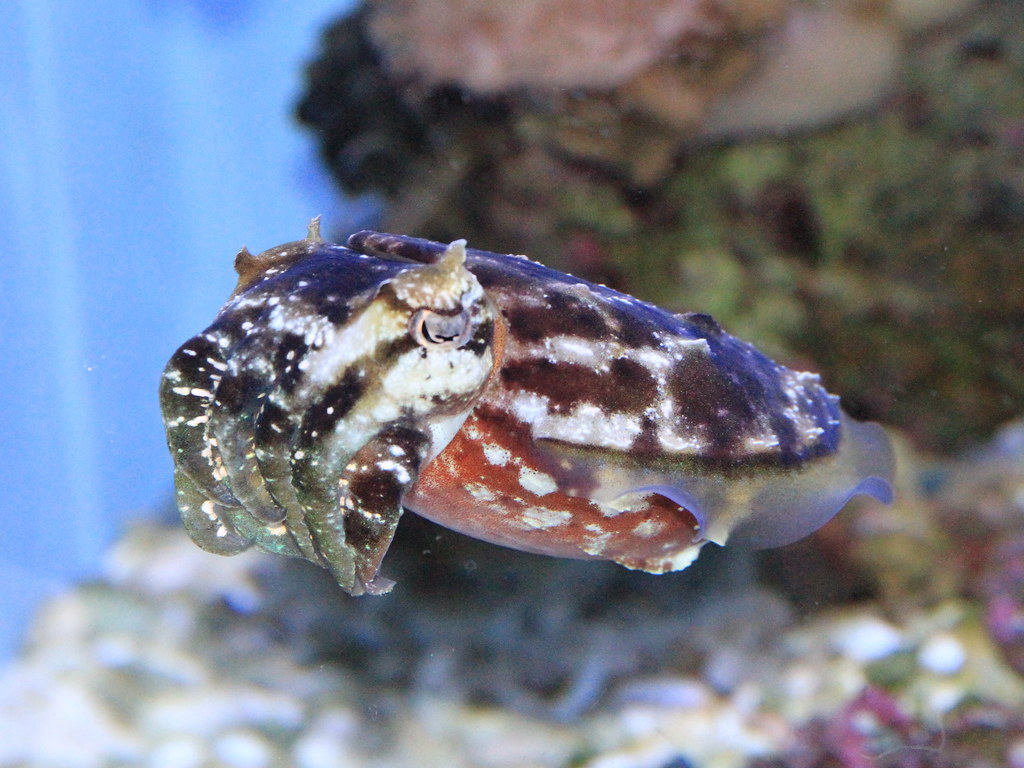
Sepia bandensis
| Identification | Small, stocky cuttlefish with mottled brown-and-white camouflage and the ability to flash colors and raised skin flaps. Also called the Stumpy-Spined or Dwarf Cuttlefish. |
| Origin | Indo-Pacific — coastal reefs and rubble of the Western Pacific |
| Maximum Length | 3–4 inches (mantle) |
| Minimum Tank Size | 30 gallons (dedicated species tank) |
| Reef Compatibility | Not a reef animal — a predator; keep in a species tank |
Behavior
The Dwarf Cuttlefish is the most commonly kept cuttlefish in the aquarium hobby, prized for its small size, expressive color-changing displays, and remarkable intelligence. It hovers and hunts using undulating fins and a pair of long feeding tentacles, and it interacts with its keeper, tracking movement with its w-shaped pupils. It is captive-bred more often than most cephalopods, which makes it the best cuttlefish choice for a dedicated keeper — though it is still a short-lived, specialized animal.
Diet & Feeding
Carnivore. Feeds on shrimp and small fish, ambushing prey with its feeding tentacles. In captivity it prefers live foods — live saltwater shrimp (mysis, ghost, or amano) and small fish — though captive-bred individuals can sometimes be trained onto frozen. Feed daily.
Cautions
A short-lived species (typically under a year to about 18 months) and a specialized animal — keep in a dedicated species tank with pristine, stable water. Provide live or well-established frozen foods and a soft sand bed. Like all cephalopods it is an escape artist, so a fully sealed lid is essential. Keep alone or only with others of its kind in a large enough tank. Not reef safe.