
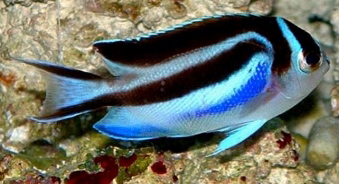
Genicanthus bellus
| Identification | Males have a white body with black horizontal stripes on the upper half and a yellow nape; females are predominantly white with black markings on the dorsal fin and tail. |
| Maximum Length | 7 inches |
| Origin | Central Pacific — Marshall Islands, Philippines, Cocos-Keeling Islands |
| Minimum Tank Size | 100 gallons |
| Reef Compatibility | Yes — one of the most reef-safe angelfish species |
Behavior
The Bellus Angel belongs to the Genicanthus genus — a group of angelfish that are true planktivores, making them far more reef-safe than most other angels. Unlike typical angelfish that graze on corals and sponges, the Bellus Angel feeds primarily in open water on zooplankton. It is a graceful, elegant swimmer that prefers the middle to upper water column. Best kept as a mated pair or a single male with multiple females. Males and females are distinctly different in coloration (sexual dimorphism). It is generally peaceful toward other species.
Diet & Feeding
Omnivore — primarily planktivorous. In captivity feed high-quality frozen mysis shrimp, marine zooplankton, brine shrimp, and quality angelfish-formula pellets. Feed 2-3 times daily. Does not require algae-based foods as heavily as other angels.
Cautions
Requires excellent water quality and a well-established system. Can be shy initially — provide caves and overhangs for shelter. May be slow to accept prepared foods at first; live or frozen brine shrimp can help with the transition. More expensive and less commonly available than other angels.