
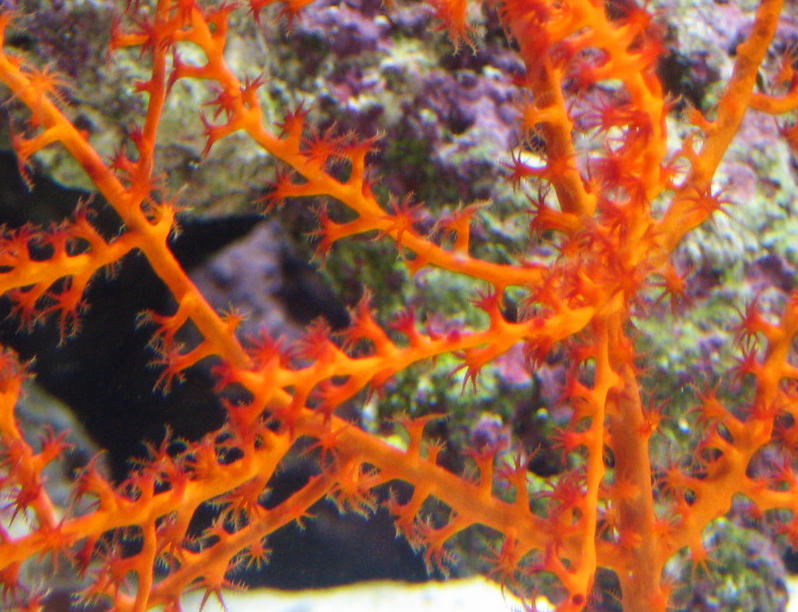
Muricea elongata
| Care Level | Easy — a genuinely good beginner gorgonian |
| Lighting | Moderate to high — it is photosynthetic |
| Water Flow | Moderate to strong |
| Placement | Upright on rock, mid to upper tank |
| Feeding | Photosynthetic; supplemental feeding optional |
| Coloration | Rusty burnt orange, sometimes toward yellow |
| Maximum Size | Around 18″ tall |
| Origin | Caribbean and Florida Keys |
Overview
The Orange Polyp Gorgonian is a branching photosynthetic sea rod in a rusty, burnt orange, densely covered in polyps that give the whole colony a soft fuzzy outline when they are open. It is collected in the Florida Keys and across the Caribbean, where it grows in some genuinely punishing shallow-water conditions — and that hardiness carries straight over into the aquarium. Colour runs from deep rust to a lighter yellow-orange depending on the specimen.
It is also sold as the Rusty Gorgonian, the Rusty Orange Spiny Gorgonian, or the Spiny Orange Sea Rod. All the same animal.
Photosynthetic or Not — Check Before You Buy
This is the single most important thing to establish before you buy any orange gorgonian. Muricea elongata is photosynthetic — it carries zooxanthellae, it feeds itself off your lights, and it is hardy enough to recommend to a beginner.
But the common name “orange polyp gorgonian” is also applied to Swiftia exserta, a deepwater species that is non-photosynthetic. Swiftia gets nothing from light and must be target fed fine particulate several times a day, every day, indefinitely. It is an expert-only animal with a poor survival record in home tanks, and it will slowly starve to death under the care instructions on this page.
Telling them apart: Muricea is a stout, spiny, rusty-orange sea rod with polyps the same general colour as the branches. Swiftia is a finer, flatter, more open branching fan, typically deep red or orange-red with contrasting bright orange polyps that stand out sharply against the branch. If a vendor is selling an orange gorgonian as a delicate deepwater specimen, or it arrived through a non-photosynthetic coral supplier, assume Swiftia and do not follow this care sheet.
Care & Placement
Mount it upright — gorgonians are built to stand into the current, not lie against rock. Epoxy or glue the base to a plug or directly into a hole in the rockwork, positioned mid to upper tank where it gets moderate to high light. Give it moderate to strong flow: good water movement keeps detritus off the branches and keeps the polyps extended, and this species handles more flow than most people give it.
Feeding
Photosynthetic, so it is largely self-sufficient under adequate lighting and needs no feeding regime to survive. It will accept fine particulate foods, and occasional broadcast feeding of phytoplankton or a fine coral food will support faster growth, but this is genuinely optional. If your gorgonian is declining, look at light, flow and cleanliness first — food is rarely the limiting factor for this species.
Propagation
Straightforward. Cut a branch with sharp scissors or a scalpel, and glue the cut end to a plug or rock. Keep flow moderate around the frag while it seals, and treat cuts as you would any coral cut — clean tools, and do not leave a ragged crush. Frags typically attach and resume growth within a few weeks.
Cautions
The main killer is algae and detritus settling on the branches. If flow is too low, film algae and cyano will colonise the surface, the polyps stay retracted, and the tissue underneath recedes — blow it off gently with a turkey baster and increase flow if you see this starting. Retracted polyps for a day or two after shipping or a move is normal; retracted polyps for a week with a filmy surface is not. Watch also for tissue recession creeping up from the base, which usually means the mount is unstable or the base is buried in detritus.