
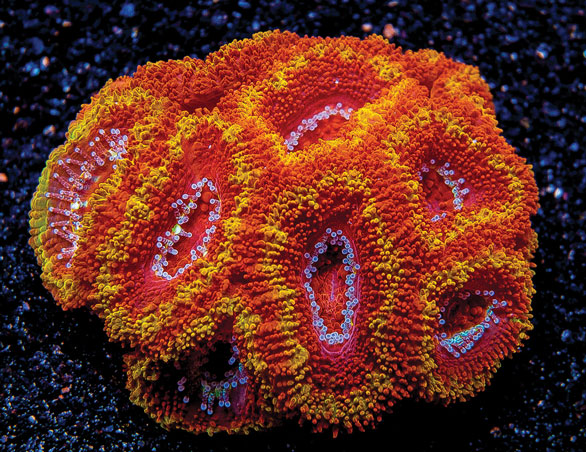
Micromussa lordhowensis
| Care Level | Easy to moderate |
| Lighting | Low to moderate |
| Water Flow | Low to moderate |
| Placement | Rock or sand, low to mid tank |
| Aggression | Semi-aggressive (short night sweepers) |
| Coloration | Rainbow — red, green, orange, purple |
Overview
Micromussa lordhowensis — still widely sold as the “Acan Lord” or “Micro Lord” from its former name Acanthastrea lordhowensis — is one of the most popular LPS corals in the hobby, prized for jaw-dropping rainbow color combinations across its fleshy, rounded polyps. It forms encrusting colonies of individual corallites and is endlessly collectible, with premium pieces named and traded by the polyp.
Care & Placement
Easy to moderate and very rewarding. It prefers low to moderate light and gentle flow — too much of either washes out the color and keeps the polyps from inflating. Place it on rock or the sand bed in the lower half of the tank. This is a coral you keep dimmer and feed well, rather than blasting with light. It is a different animal from our Acanthastrea acan-coral page, despite the shared “acan” nickname.
Feeding
Feeding is the key to Micromussa. It is photosynthetic, but it responds dramatically to being fed — offer small meaty foods (mysis, chopped seafood, pellets, or an LPS food) placed directly on the polyps a couple of times a week. Regular feeding drives faster growth, fuller polyps, and better color.
Propagation
Easy to frag with a band saw: cut between corallites so each frag carries one or more whole polyps, then glue to a plug. It heals and encrusts readily, which is why colorful named frags are so widely traded.
Cautions
Generally peaceful but it can extend short sweeper tentacles at night, so leave a little space from close neighbors. Keep light and flow modest; the most common mistake is too much light, which bleaches out the very colors people buy it for.
Frequently Asked Questions
Is Micromussa the same as an Acan Lord?
Yes. “Acan Lord” and “Micro Lord” are the hobby names for Micromussa lordhowensis, formerly Acanthastrea lordhowensis. It is a different species from the Acanthastrea on our acan-coral page.
How do I get the best color from my Micromussa?
Keep it under low to moderate light with gentle flow, and feed it regularly. Bright light tends to bleach the rainbow coloration, while dimmer light plus frequent feeding brings out the deep reds, greens, and oranges.
Is Micromussa a good beginner LPS?
Yes — it is hardy, forgiving, and undemanding on light and flow, and one of the most rewarding corals to feed. Just keep it out of intense light and give it stable water.