
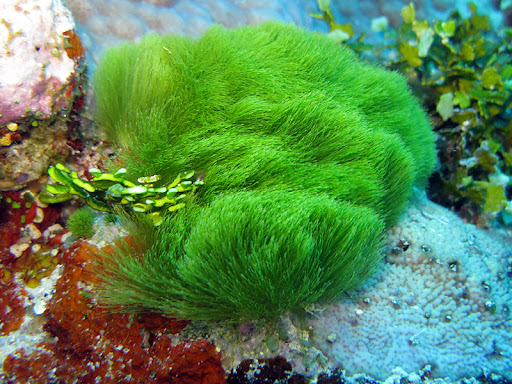
Chlorodesmis fastigiata
| Care Level | Easy to moderate |
| Lighting | Moderate to high |
| Water Flow | Moderate to strong |
| Placement | Display, attached to rock |
| Primary Use | Ornamental display macroalgae |
| Growth Rate | Moderate |
Overview
Maiden’s Hair Algae (Chlorodesmis), also called turtle weed, forms dense, bright-green tufts of fine, soft, hair-like filaments that sway beautifully in the current. Unlike most macroalgae it is grown purely for its looks as a display plant — it stays put in neat clumps rather than spreading messily, and its vivid green is a standout on the rockwork.
Care & Placement
Easy to moderate. Give it moderate to high light and moderate to strong flow, attached to rock in the display where the fine strands can flow. It attaches and holds its spot well. It is chemically defended, so most herbivores leave it alone — a plus for a display plant, since it will not simply be eaten, though it means it does not double as fish food.
Uses & Nutrient Export
Primarily ornamental. It takes up some nutrients as it grows, offering modest export, but its real value is aesthetic — a lush green accent that most tangs and grazers will not touch, so it survives in a display where softer greens would be eaten.
Propagation & Harvesting
Spreads slowly by attaching to and creeping across rock. Propagate by splitting a clump and wedging or gluing a portion onto new rock. It is far less invasive than Caulerpa, so it rarely needs aggressive harvesting.
Cautions
It is chemically defended and can wage mild chemical warfare on nearby corals, so give it a little space from sensitive pieces and run activated carbon. Because grazers avoid it, your cleanup crew will not control it — manage its spread manually if needed.
Frequently Asked Questions
Will fish eat Maiden’s Hair Algae?
Usually not. Chlorodesmis is chemically defended, so most tangs and herbivores leave it alone — which is why it works as a display plant that survives among grazers, unlike softer greens that get eaten quickly.
Is Maiden’s Hair Algae invasive?
Much less so than Caulerpa. It spreads slowly by attaching to rock and stays in fairly neat clumps, so it is easy to keep contained, and it does not have Caulerpa’s boom-and-crash sexual events.
Does Maiden’s Hair Algae need strong light?
It does best under moderate to high light with good flow, which keeps the fine strands lush and green. In weak light or stagnant flow it can thin out and decline.