
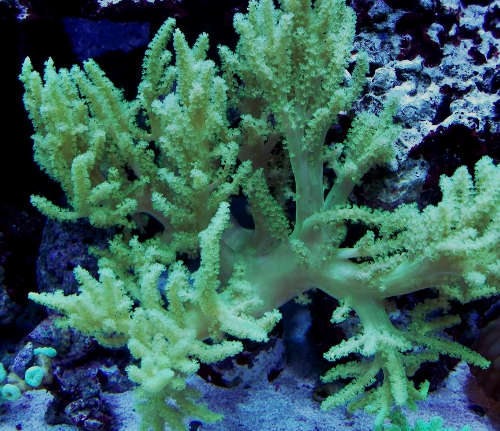
Sinularia sp.
| Care Level | Easy — great for beginners |
| Lighting | Low to moderate |
| Water Flow | Moderate |
| Placement | Rock, mid to lower tank |
| Aggression | Peaceful, but grows large |
| Coloration | Green |
Overview
The Green Sinularia is a hardy, fast-growing soft (leather) coral in an attractive green, forming finger-like or lobed branches. It is one of the best beginner soft corals: forgiving, undemanding, and quick to grow into an impressive colony that adds body and movement to a reef.
Care & Placement
Easy. Give it low to moderate light and moderate flow. Every so often it sheds a waxy surface film to clean off algae and debris, closing up for a day or two while it does — this is normal self-cleaning, not a problem. Give it room, since it grows large and can shade or crowd smaller neighbors.
Feeding
Photosynthetic. It gets most of its energy from light through its zooxanthellae, so supplemental feeding is not required. It will absorb some dissolved nutrients from the water, but stable parameters and adequate light matter far more than feeding.
Propagation
Very easy. Cut a branch with a clean, sharp blade and attach it to a piece of rubble — rubber-band or glue it until it grabs hold. Leather corals frag readily and heal quickly.
Cautions
Like other soft corals it wages chemical warfare, releasing terpenoid compounds that can irritate or suppress nearby corals, especially SPS. Run activated carbon and give it space from sensitive neighbors. Its periodic shedding and closing-up cycle is normal and nothing to treat.
Frequently Asked Questions
Is Green Sinularia good for beginners?
Yes. It is one of the hardiest, most forgiving soft corals, tolerant of a range of light and flow, and it grows fast. It is a great first coral.
Why is my Sinularia closed up and slimy?
It periodically sheds a waxy surface film to clear off algae and debris, closing up for a day or two while it does. This is normal self-cleaning, not a sign of trouble.
Does Green Sinularia need to be fed?
No. It is photosynthetic and gets its energy from light, so supplemental feeding is not necessary. Good lighting and stable water are what it needs.