
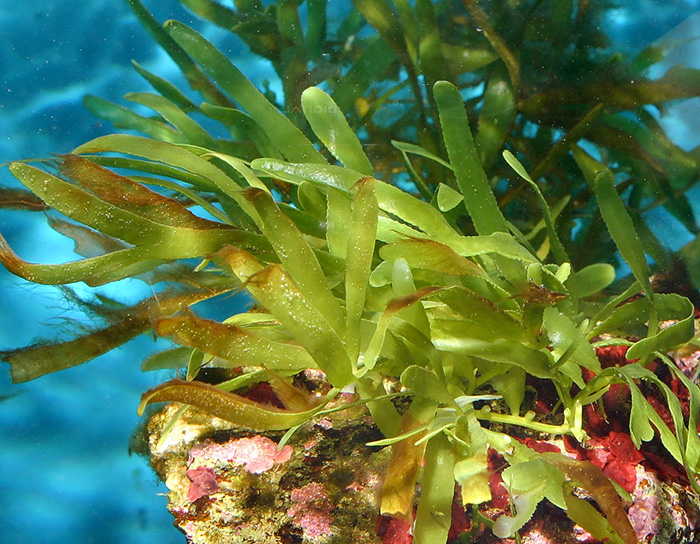
Caulerpa prolifera
Telling it apart. This is the plain-bladed Caulerpa: flat, undivided, strap-like blades rising straight from a creeping runner, with no branchlets or feathering whatsoever. New blades frequently sprout from the face of older ones, which is what the name prolifera refers to. Compare Feather Caulerpa (C. mexicana), whose fronds are divided into feather-like branchlets.
| Care Level | Easy |
| Lighting | Moderate |
| Water Flow | Low to moderate |
| Placement | Refugium, or a sand bed for a seagrass look |
| Aggression | Peaceful, but invasive |
| Coloration | Bright to olive green |
Overview
The simplest and arguably the most elegant of the common Caulerpas — broad, flat green straps rising from runners across the sand, looking for all the world like a bed of turtle grass. It is a Florida and Caribbean species, and that seagrass-meadow look is why people keep it in a display as much as in a refugium: it is the go-to alga for a lagoon or seagrass biotope.
Care & Placement
Easy. Moderate light and gentle flow suit it, and it will run happily across sand as well as rock — in fact a sand bed shows it at its best, since the runners spread out into a proper meadow. As with any Caulerpa, confine it or commit to harvesting, because those runners do not respect boundaries.
Feeding
Photosynthetic, drawing nitrate and phosphate out of the water as it grows. Its broad blades make it an effective exporter, but as always the nutrients only leave the system when you harvest and remove the growth.
Propagation
Trivially easy. Snip a runner carrying a blade or two and press it into the sand or wedge it in rubble; it anchors and spreads on its own.
Cautions
The caution that matters with any true Caulerpa: it can “go sexual” (sporulate) — releasing its contents into the water, turning it milky, and dying back all at once, which can crash water quality overnight. Reduce the risk by harvesting regularly so the algae never grows old and crowded, avoiding sudden lighting changes, and running refugium light on a reverse or 24-hour schedule. It is also genuinely invasive and will creep over corals if left unchecked, and some regions restrict Caulerpa species outright — check your local rules.