
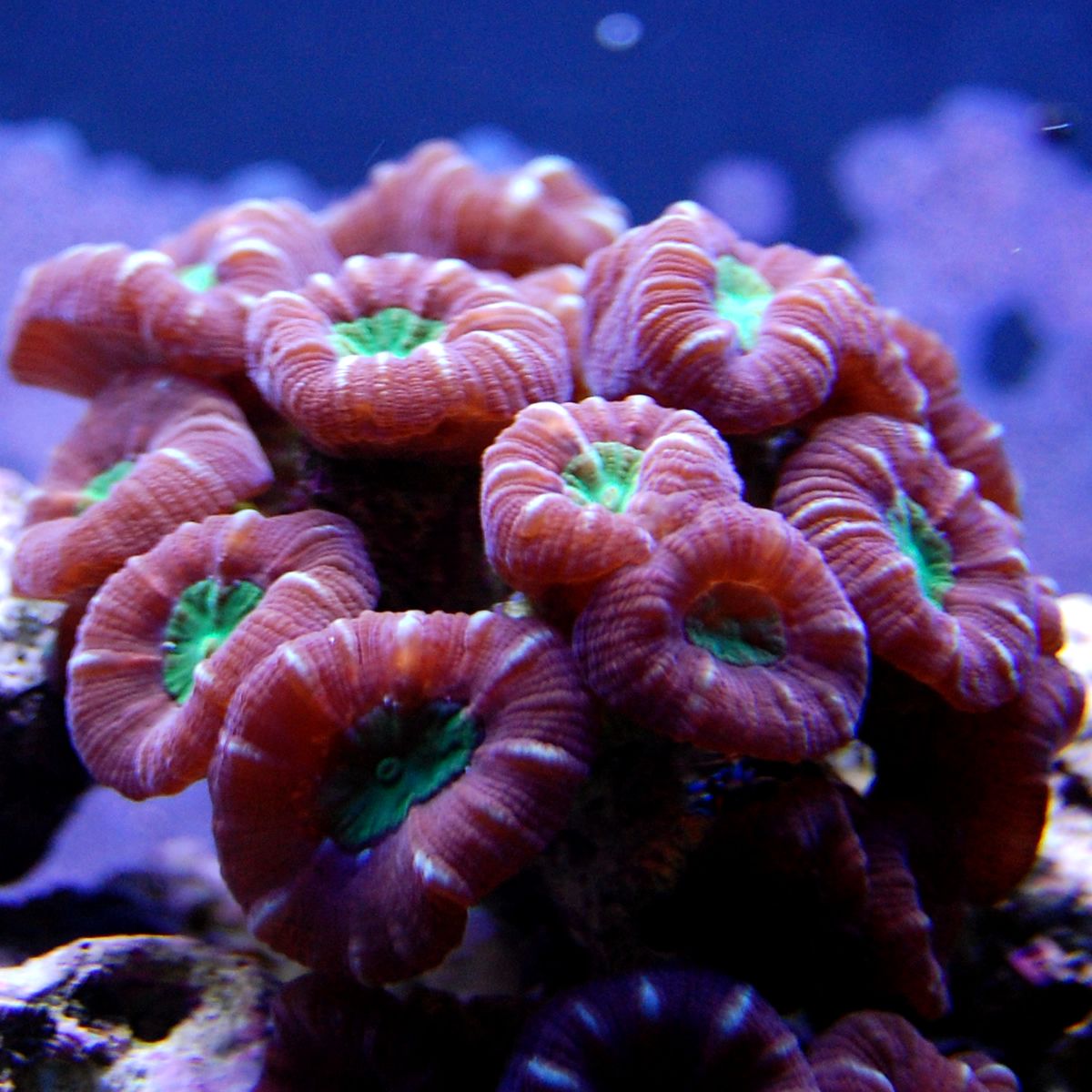
Caulastraea furcata
| Care Level | Easy — great beginner LPS |
| Lighting | Low to moderate |
| Water Flow | Low to moderate |
| Placement | Low to mid rock |
| Aggression | Peaceful |
| Coloration | Green, brown, or teal with striped heads |
Overview
The Candy Cane (or Trumpet) Coral forms clusters of rounded polyps on trumpet-shaped branches, often with candy-striped coloration that glows under blue light. It is hardy, fast-growing, and peaceful — an excellent beginner LPS that quickly multiplies into an eye-catching colony.
Care & Placement
Give low-to-moderate light and gentle-to-moderate flow. Place low-to-mid on rockwork with room to spread. Well-fed candy canes bud new heads readily and form dense clusters.
Feeding
Photosynthetic and an eager feeder — target-feed meaty foods (mysis, chopped seafood) once or twice a week and it will pump out new heads quickly.
Propagation
Very easy to frag — snip individual heads off the branching skeleton with bone cutters and glue to a plug.
Full step-by-step: How to Frag Acans, Favia and Other Rock-Skeleton LPS
Cautions
Peaceful, though it can extend short feeder tentacles at night — give a little space. One of the most forgiving and rewarding beginner LPS.
Frequently Asked Questions
Is candy cane coral good for beginners?
Yes. Also called trumpet coral, it’s a hardy, forgiving beginner LPS that grows into an attractive branching colony of rounded heads.
What light and flow does candy cane coral need?
Low to moderate light and low to moderate flow. It’s undemanding and tolerates a range of conditions.
Should I feed candy cane coral?
Yes. It responds well to spot-feeding meaty foods at night when its feeder tentacles are out, which encourages it to split and add new heads.