
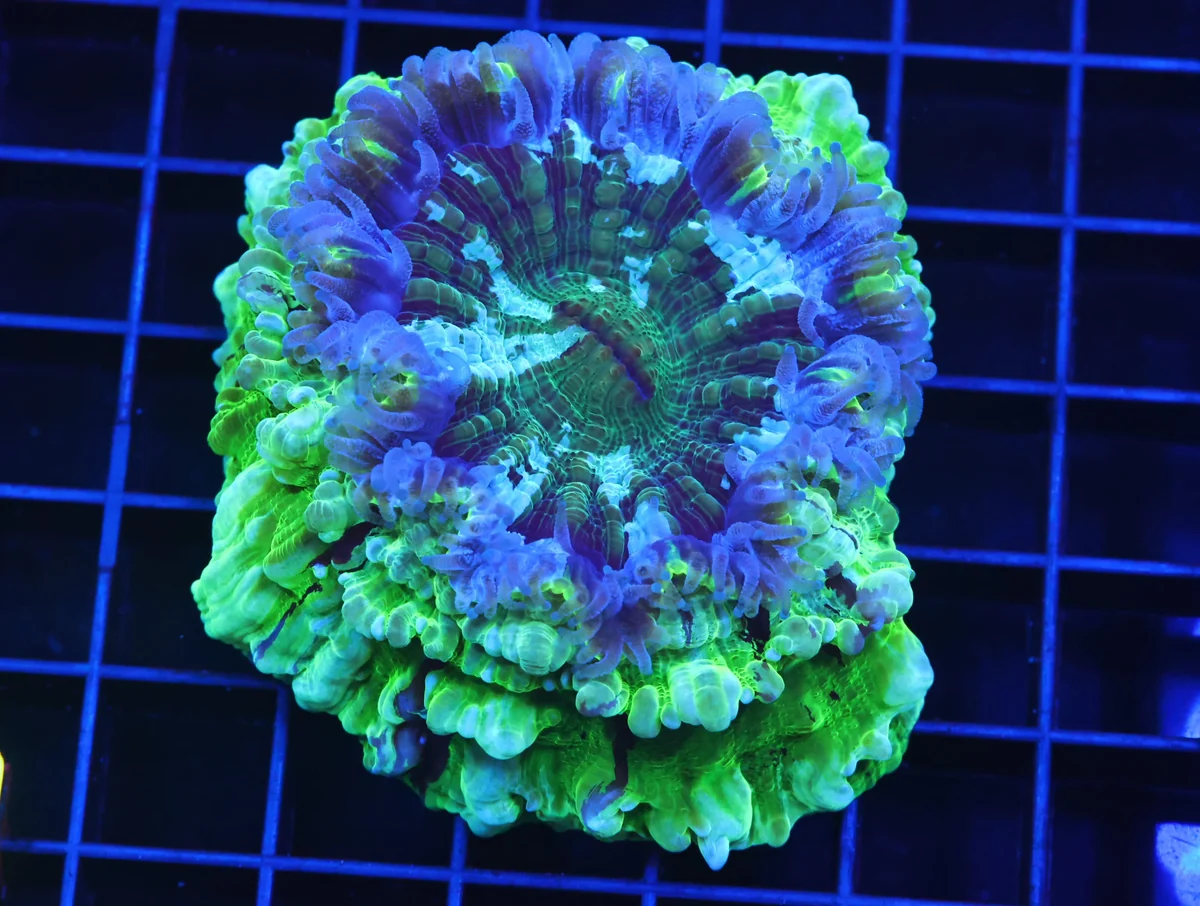
Acanthophyllia deshayesiana
| Care Level | Moderate |
| Lighting | Low to moderate |
| Water Flow | Low |
| Placement | Sand bed (free-living) |
| Aggression | Peaceful |
| Coloration | Rainbow — red, green, orange |
Overview
Acanthophyllia is a large, single-polyp fleshy brain coral — a prized, frequently rainbow-colored relative of Cynarina and Scolymia that inflates into a stunning dome of tissue. It is a free-living coral that rests on the sand, and one of the most collectible LPS “meat corals” in the hobby.
Care & Placement
Moderate. Give it low to moderate light and gentle flow, and place it on the sand bed rather than rock, since it is free-living. Too much light or flow prevents it from inflating and can tear the swollen tissue, so keep both modest and handle it gently.
Feeding
Feeding drives its growth. It is photosynthetic, but at night it extends feeding tentacles — target-feed small meaty foods a couple of times a week for faster growth and richer color.
Propagation
Rarely fragged: as a single-polyp coral, dividing it means bisecting the entire animal, which is an advanced procedure. It is almost always kept and sold as a whole specimen.
Cautions
The fleshy tissue is delicate. Avoid strong flow, sharp rockwork, and rough handling, all of which cause tears that can become infected. Give it open space on the sand, as it can extend sweeper tentacles after dark.
Frequently Asked Questions
Is Acanthophyllia hard to keep?
It is moderate. Give it low light, gentle flow, a sand-bed placement, and regular feeding, and it is quite rewarding. The main risks are tissue damage from too much flow or rough handling.
Where should I place Acanthophyllia?
On the sand bed, not on rock. It is a free-living coral that naturally sits on soft substrate, and placing it in low flow lets it fully inflate.
Should I feed Acanthophyllia?
Yes. Although photosynthetic, it responds strongly to target feeding of small meaty foods at night, which noticeably improves growth and coloration.