
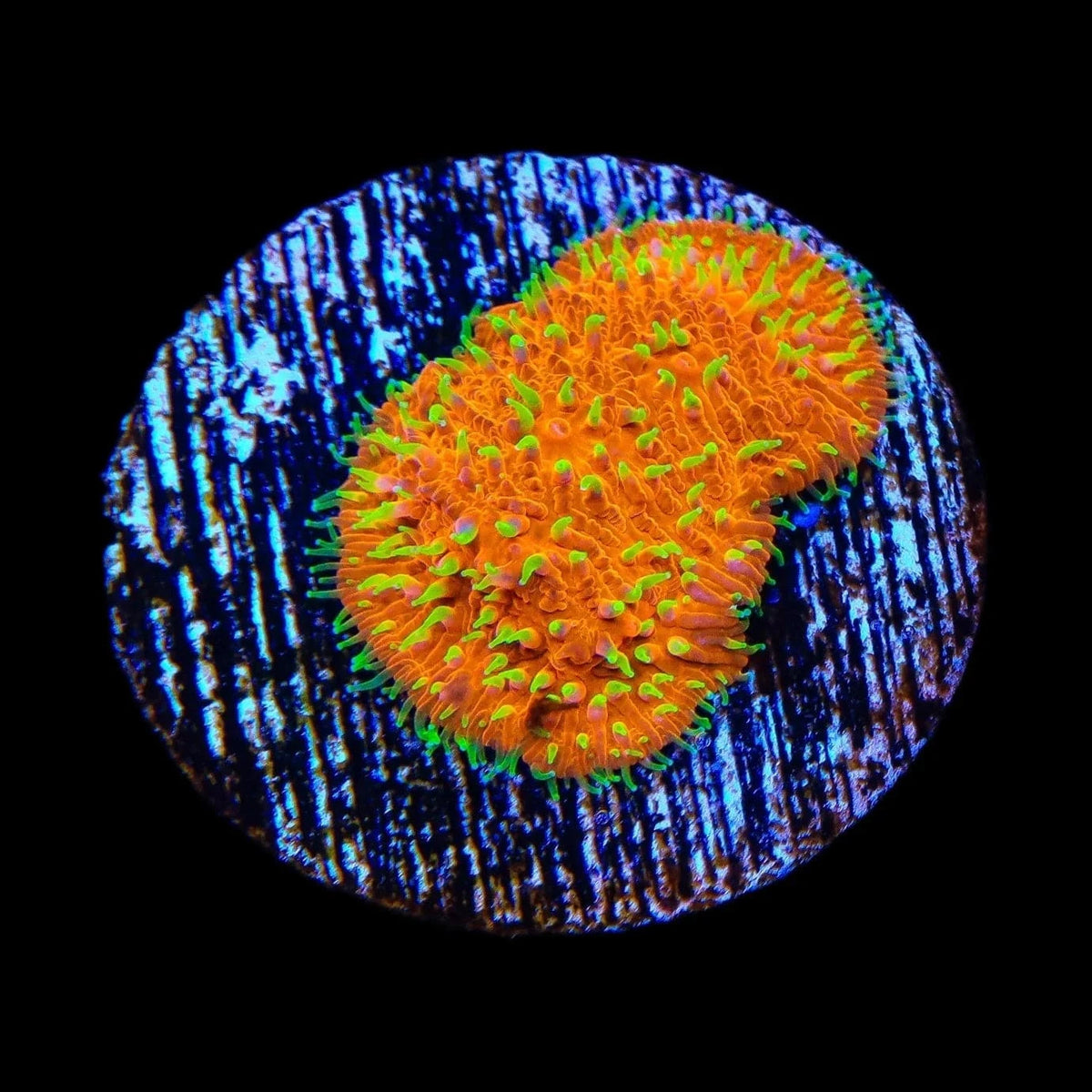
Lithophyllon sp.
| Care Level | Easy to moderate |
| Lighting | Low to moderate |
| Water Flow | Low to moderate |
| Placement | Rock, low to mid tank |
| Aggression | Semi-aggressive (night sweepers) |
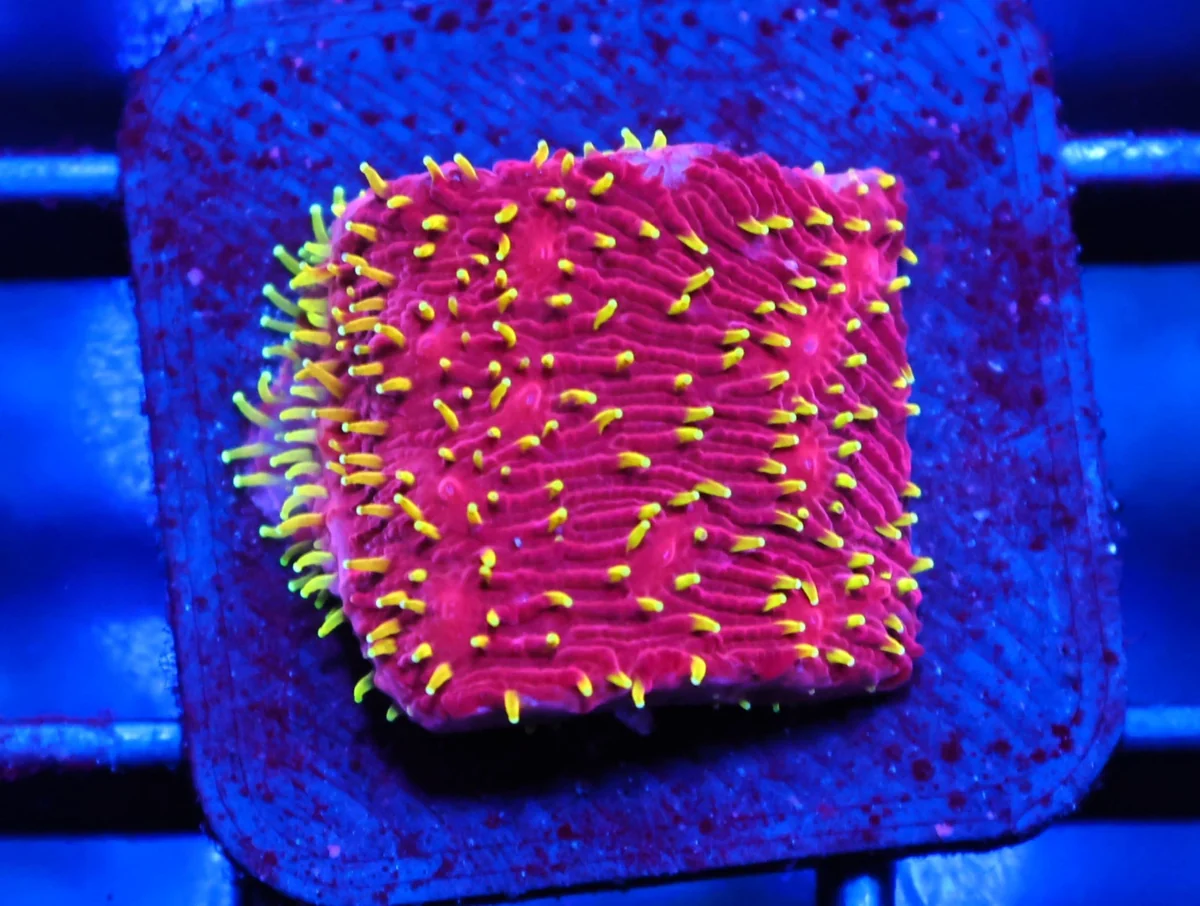
| Coloration | Bright green, orange, red, rainbow |
Color Variations
Lithophyllon is available in several designer color morphs. The coloration is purely cosmetic — every one takes the same care described above.
Overview
Lithophyllon is a plating, encrusting stony coral — a relative of the plate corals — that has become popular for its smooth, chalice-like growth and intense, often fluorescent coloration in greens, oranges, and reds. It is frequently mistaken for a true chalice (Echinophyllia or Mycedium) because of the similar plating look, but it is its own coral with the same easygoing, colorful appeal.
Care & Placement
Easy to moderate and very chalice-like in its needs: give it low to moderate light and gentle to moderate flow, and place it on rock in the lower half of the tank. Acclimate it slowly to your lighting, since a piece grown under softer light can pale or bleach if moved straight into bright conditions. Once settled it encrusts and plates outward across the rock.
Feeding
Photosynthetic and largely self-sufficient on light, but it responds very well to feeding: at night it extends small feeding tentacles that will take fine meaty foods or a coral food. Spot-feeding a couple of times a week noticeably improves color and growth.
Propagation
Easy: cut a section of the plate with a saw or bone cutters and glue it to a plug or rubble. Like chalices it encrusts and heals readily, and it is commonly propagated and traded as colorful frags.
Cautions
Like true chalices it can extend short-to-medium sweeper tentacles at night that sting close neighbors, so leave a little space around it. Acclimate it to light gradually to avoid bleaching, and give its encrusting plates room to spread without overgrowing slower corals.
Frequently Asked Questions
Is Lithophyllon the same as a chalice coral?
No, but it is easy to confuse them. Lithophyllon is a plating relative of the plate corals, while true chalices are Echinophyllia, Mycedium, or Oxypora. They share a similar plating look and similar care, which is why the names get mixed up.
Does Lithophyllon need to be fed?
It does not require feeding to survive, since it is photosynthetic, but it responds strongly to it. Feeding small meaty or coral foods at night, when its tentacles are out, brings out better color and faster growth.
Why did my Lithophyllon lose its color?
Usually a lighting change — a piece grown under moderate light can pale or bleach if moved into bright light too quickly. Acclimate it gradually, keep flow gentle, feed it, and hold parameters stable to bring the color back.