
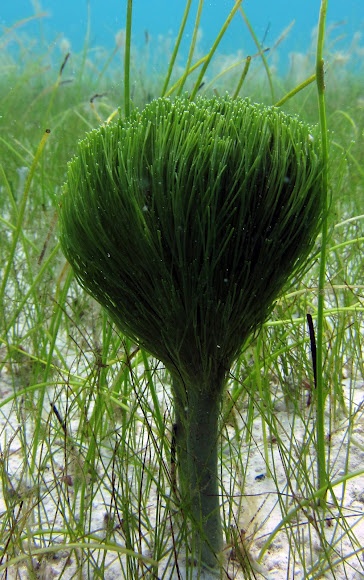
Penicillus dumetosus
| Care Level | Moderate |
| Lighting | Moderate to high |
| Water Flow | Low to moderate |
| Placement | Planted in sand — it cannot be attached to rock |
| Aggression | Peaceful, non-invasive |
| Coloration | Pale to medium green, often dusted chalky white |
Overview
One of the most instantly recognisable macroalgae in the hobby: a stiff, calcified stalk topped with a dense tuft of fine green filaments, looking for all the world like an old-fashioned shaving brush. A Caribbean sand-dweller related to Halimeda and Udotea, it brings a genuinely natural, sea-grass-flat look to a sand bed or display refugium — and unlike Caulerpa it does not spread or turn invasive.
Care & Placement
The critical point is placement: it anchors with a bulbous, root-like holdfast that must be planted into a sand bed. It cannot be glued or wedged onto rock the way Chaetomorpha or Caulerpa can, and it will not survive that way. Give it at least a couple of inches of sand, moderate to strong light, and gentle flow. Because it lays down calcium carbonate like Halimeda, it also needs the same stable calcium, alkalinity and magnesium you would maintain for corals.
Feeding
Photosynthetic, taking up nitrate and phosphate as it grows, though its export capacity is modest — this one is kept for its looks far more than for nutrient control. Being a calcifying alga it also draws on calcium, alkalinity and magnesium, so factor it into your dosing along with the corals.
Propagation
Slow and largely self-directed. New brushes push up from the holdfast area over time rather than from cuttings, so it is not propagated the way a Caulerpa is — give an established planting time and it will gradually form a small stand.
Cautions
Be aware that individual brushes are relatively short-lived. Like many of its relatives it can reproduce and then die back, with a brush going pale and collapsing after releasing its spores — often leaving new growth behind. That is normal rather than a husbandry failure, but it does mean you should treat a planting as something that renews itself over time rather than a permanent fixture. It also demands a sand bed and stable calcium and alkalinity, and while its calcified stalk deters many grazers, urchins and determined tangs will still have a go at it.