
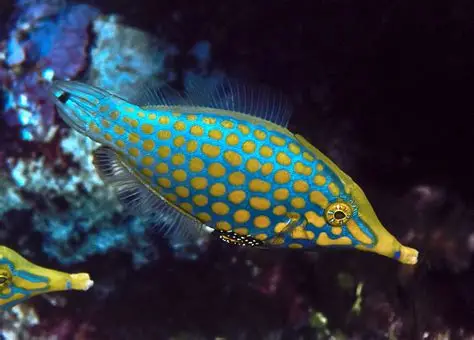
Oxymonacanthus longirostris
| Identification | Small, laterally compressed filefish with a long pointed snout and a vivid sky-blue to turquoise body covered in evenly spaced orange spots. The first dorsal spine is slender and erectile. Females are slightly plumper when gravid; males may display faint additional markings near the caudal peduncle. One of the most striking filefish in the trade. |
| Maximum Length | 5 inches (12 cm) |
| Origin | Indo-Pacific — East Africa to Samoa, southern Japan to Australia; typically found in and around Acropora coral colonies |
| Minimum Tank Size | 55 gallons (species-specific setup required) |
| Reef Compatibility | No — obligate corallivore; will eat Acropora and other SPS coral polyps |
Behavior
The Orange Spotted Filefish is a peaceful, shy species that is almost always found in pairs or small groups hovering directly over Acropora coral colonies in the wild. It uses its long, specialized snout to nibble individual coral polyps. In the aquarium it is completely non-aggressive toward unrelated fish but may be harassed by boisterous tankmates — keep it only with calm, similarly sized species. If kept in pairs, a male and female introduced together will often bond and display natural courtship behavior. This species has a narrow home range in the wild and does not need a large aquarium, but it does require a very stable, stress-free environment.
Diet & Feeding
One of the most challenging fish to feed in the hobby. In the wild it feeds almost exclusively on Acropora coral polyps and associated mucus, making it an obligate corallivore. In captivity it must be weaned onto substitute foods, which succeeds only with patient target feeding. Start with live or frozen copepods and amphipods, then transition to frozen mysis shrimp, vitamin-enriched brine shrimp, and finely chopped meaty seafood. Some specimens will learn to accept small pellets or flake once acclimated. Feed multiple small portions per day. Captive-bred or tank-raised specimens (when available) acclimate far more readily. This fish is recommended for experienced aquarists only.
Cautions
Not reef safe — will consume Acropora, Stylophora, and other SPS coral polyps even in a well-fed specimen. Keep only in a fish-only or FOWLR system. Highly specialized dietary requirements make this one of the more difficult marine fish to sustain long-term; research thoroughly before purchase and ensure a steady supply of suitable foods. Prolonged starvation is the most common cause of loss in captivity.